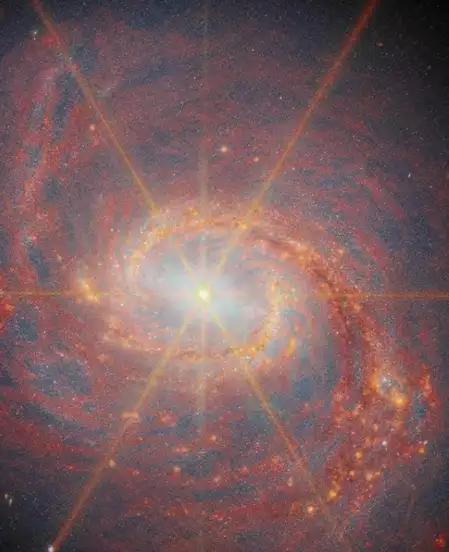
New Delhi, May 8 (IANS). American space agency NASA has released three spectacular pictures of Galaxy M-77 with the help of James Webb Space Telescope. In these pictures, the center of the galaxy is shining so brightly that the entire galaxy is seen glowing. The most special thing is the ‘diffraction spikes’ seen in these pictures, which is an optical effect caused by the optics of the telescope.
These diffraction spikes are not the actual structure of the galaxy but an optical effect of the telescope. Galaxy M-77 is a spiral galaxy and one of the galaxies with an active center. These NASA photos will help scientists better understand the activity around black holes, the formation of new stars and the structure of the galaxy.
NASA wrote with these pictures, “Don’t let anyone dim your shine.” The center of Galaxy M-77 is so bright because the gas is rotating at very high speed around its central black hole. Due to this rapid rotation the gas gets heated and releases huge amount of energy and radiation.
The first picture is the mid-infrared view. In this picture, the bright glow emanating from the center of the galaxy attracts the most. Six large and two small bright orange rays are radiating outward from the center. These rays are actually ‘diffraction spikes’, which are caused by the design of the Webb telescope. Orange glowing bubbles are visible in the galaxy’s spiral arms, which are groups of newly formed stars or star clusters. The rest of the galaxy appears to be filled with blue swirling clouds of dust.
At the same time, the second picture is a near-infrared view, in which a ‘bar’ (bar structure) 6 thousand light years long is clearly visible in the center of the galaxy. This bar is surrounded by a bright ring, which is called ‘Starburst Ring’. This ring is formed by the inner ends of the two spiral arms of the galaxy. Starburst regions are places where new stars are forming very rapidly. Here also six long bright rays i.e. diffraction spikes are coming out from the centre.
The third image is a combination of both infrared views. This picture has been created by combining both mid-infrared and near-infrared. In this, the complete beauty and scientific importance of the Galaxy is visible together. Diffraction spikes emanating from the center, starburst rings, spiral arms and dust clouds are all clearly visible. The design of the Webb telescope results in a six-plus-two-dot pattern around bright objects, whereas the Hubble telescope shows a four-dot pattern.
–IANS
mt/pm