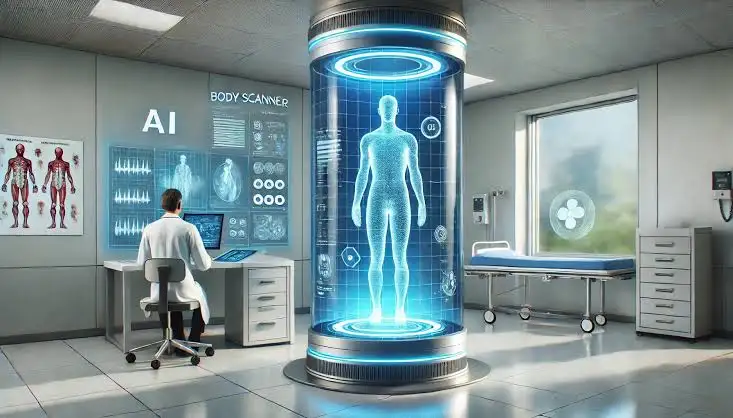
Will the advent of AI-powered full-body scans make MRIs obsolete? This question arose when ‘Midjourney’, a company famous for AI image making models, introduced a new scanner. The company claims that this medical device – which is being called a “midjourney scanner” – can provide MRI-like results in a very short time, without any radiation. It is noteworthy that in recent times, tech companies are paying more attention to AI hardware.
How will MidJourney Scanner work?
MidJourney CEO David Holz described the project as “weird and unique” but brilliant and hopeful. This scanner is an ultrasonic device that can scan the entire body using sensors; For this process the user has to stand in water for a minute. According to the company, the sensors installed in the device send ultrasonic waves from different angles to the body. These waves capture vertical cross-sections of the body’s interior, creating a 3D map of muscles, fat, bones and organs. A lot of data can be collected about the internal structure of the body during the scan. The CEO claims that in many cases, this scanner can deliver MRI-like image quality.
no risk of radiation
This scanner uses sound waves and water, so it does not create radiation or magnetic fields, making it safer than MRI. While an MRI scan typically takes 30 to 90 minutes, this scanner can complete the process in just one minute. The company aims to make the full-body scanning experience like going to a spa.
When will MidJourney Scanner be available?
This scanner is still in the early stages of development and has not been clinically tested yet. The company acknowledges that diagnostic medical use will require approval from the US Food and Drug Administration (FDA), and plans to launch with ‘body composition mapping’ — a feature that is likely to receive approval soon. The company will open a MidJourney Spa in San Francisco next year, where this scanner will be installed. There will be 10 such scanners in every spa. The company plans to increase the number of these spas by 2028 and is aiming to provide 50,000 scanners in the next six years.