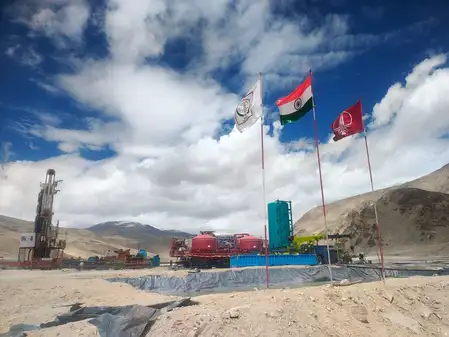
New Delhi, July 12 (IANS). Public sector Oil and Natural Gas Corporation (ONGC) has completed drilling of its second geothermal well in Puga Valley in Ladakh. This is considered an important step towards the development of India’s first pilot geothermal power plant.
ONGC Energy Centre, the research and development arm of ONGC, drilled this well to a depth of 1,000 meters at an altitude of more than 14,000 feet in about a month.
According to an ONGC statement, the work was completed in less time and at lower cost than earlier geothermal drilling campaigns.
According to the company, this new well builds on the success of the first geothermal well drilled in Puga. The first well produced steam at a temperature higher than the boiling point of water, confirming the immense potential of geothermal energy in the region.
ONGC said the second well will help in the development of India’s first 1 megawatt electric (MWE) pilot geothermal power plant and could open the way for commercial use of geothermal energy in the country.
The next phase of the project plans to set up a 1 MW capacity pilot geothermal power plant and develop geothermal resources to provide reliable base power to Ladakh in the long run.
The Puga geothermal field located in eastern Ladakh is considered to be India’s most promising geothermal resource.
Geothermal energy uses natural heat beneath the Earth’s surface to generate electricity and provide heat. It is a 24/7 source of energy with low-carbon emissions. Unlike solar and wind energy, it is considered more reliable as it is less dependent on weather.
Although the Puga region has long been considered India’s most promising geothermal region and exploration work has been carried out from time to time, geothermal power generation has not yet started on a commercial scale due to technical and economic challenges.
Meanwhile, India is moving rapidly towards the target of achieving 500 GW of non-fossil fuel based energy capacity by the year 2030. The country’s non-fossil fuel based installed capacity has increased from 81 GW in 2014 to 288 GW currently, representing an increase of over 256 per cent.
During the same period, solar energy capacity has increased from 2.8 GW to 155 GW and wind energy capacity has increased from 21 GW to 56.4 GW.
–IANS
abs