New Delhi, December 27 (IANS). In the year 2025, India has achieved many big and historic achievements in the field of space science. This year, the Indian Space Research Organization (ISRO) completed more than 200 successful space missions. ISRO Chairman V. Narayanan said that the number of missions between 2015 and 2025 is almost double that of 2005 to 2015. He said that under the leadership of Prime Minister Narendra Modi, more than 200 major achievements were achieved from January 2025 till now.
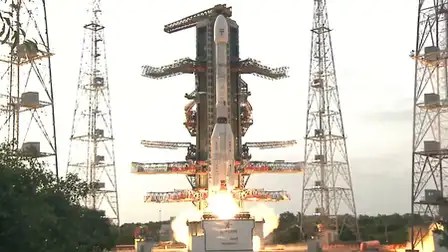
ISRO created history on Wednesday (December 24, 2025) with its last mission of this year and successfully launched the heaviest communication satellite Bluebird Block-2. Under this mission, the 6100 kg Blue Bird Block-2 communication satellite of American company AST Spacemobile was successfully placed in the low Earth orbit located 520 kilometers away in 16 minutes. LVM3 rocket was used for its launching, which is also called ‘Baahubali’ rocket due to its capabilities.
Earlier on November 2, 2025, ISRO successfully tested in-orbit ignition of the C25 cryogenic upper stage during the LVM3-M5/CMS-03 mission. This proved that India is progressing rapidly in cryogenic rocket technology.
In the same year, India also made great progress in rocket engine and cryogenic technology. On 28 March 2025, ISRO conducted a successful “hot test” of its semi-cryogenic engine (SE2000). This further strengthened India’s rocket technology.
India got a bigger achievement than its first solar mission Aditya-L1. This mission is located at the Sun-Earth L1 point. ISRO released about 15 terabytes of scientific data related to this mission to scientists around the world. This data will help advance Sun and space-weather research.
In the same year, ISRO and NASA together launched a special Earth observation satellite named NISAR. This is the world’s first radar imaging satellite, which uses two different frequencies. This satellite will study earthquakes, tsunamis, volcanoes, landslides, melting of ice sheets and changes in the environment.
On January 29, 2025, ISRO conducted its 100th rocket launch from Sriharikota. In this mission, NVS-02 satellite was sent into space through GSLV-F15 rocket. It was successfully placed in Geosynchronous Transfer Orbit (GTO). Although there was a slight problem with its orbit raising engine, due to which it could not reach the planned orbit, still it was a historic mission for India.
In January this year, India successfully docked two satellites in space under Spadex (Space Docking Experiment). On January 16, 2025, ISRO docked two Spadex satellites, SDX-01 and SDX-02. With this, India became the fourth country in the world to do so. This success is very important for sending humans to the Moon in the future and building a space station.
One of the biggest achievements of the year 2025 was that for the first time an Indian astronaut reached the International Space Station (ISS). With this, he is the second Indian to go to space after Rakesh Sharma. ISRO astronaut Shubhanshu Shukla went to ISS under Axiom-4 mission. He spent about 18 days in space, which made the entire country feel very proud.
–IANS
dBp/ms