New Delhi, April 1 (IANS). It is very important to maintain constant contact between the astronauts living in space and the team sitting on Earth. Scientists use an advanced communication system called ‘Space Network’ for this purpose. This network helps astronauts stay connected to Earth and the International Space Station.
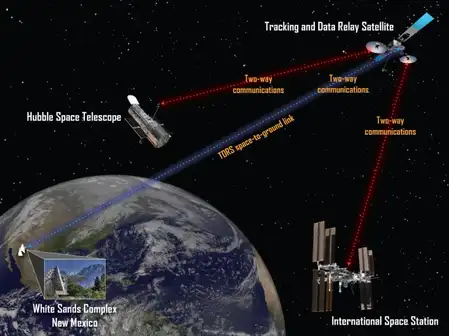
First of all it is important to understand what is space network? The space network consists of a constellation of Tracking and Data Relay Satellites (TDRS). These satellites rotate in geosynchronous orbit about 35 thousand kilometers above the Earth and work like ‘cell towers’ in space. TDRS can communicate with satellites wherever the space station is in its orbit.
When an astronaut on the space station wants to send data, video or voice to Mission Control, the station’s computer converts that data into a radio signal. This signal reaches the TDRS satellite through the antenna of the station. TDRS then relays it to the White Sands Complex in New Mexico, from where the signal reaches Houston via landline. The entire process is completed in milliseconds, so there is no delay in the conversation.
Now the question is how does the data of scientific experiments reach the Earth? Astronauts on the space station conduct many important experiments related to physics, biology, astronomy and meteorology. The scientific data obtained from these experiments is also sent to Earth through the same space network. The data is converted into radio signals and sent to the TDRS satellite, then via White Sands and Houston to scientists. Because of this system, scientists are able to obtain data in almost real time.
American space agency NASA also uses this network for education programs. The astronauts answer questions from school children through video and voice calls. When this network was not there, astronauts could communicate with Earth for only 15 minutes. Now we stay in touch almost all the time. The space network is managed by NASA’s Goddard Space Flight Center (Maryland), with strategic oversight by the SCAN Program Office.
–IANS
mt/pm