
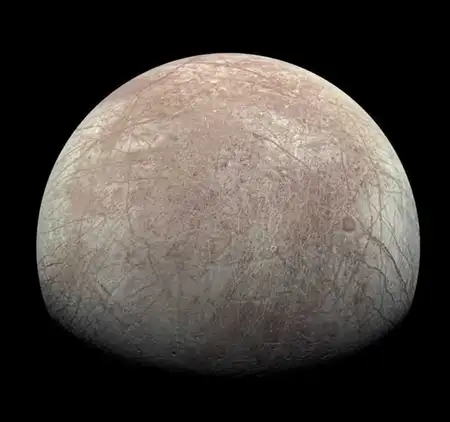
New Delhi, June 13 (IANS). It’s thrilling to imagine what the sky would look like if Jupiter’s icy moon Europa suddenly came into Earth’s orbit. American space agency NASA gives interesting detailed information about this.
NASA gave interesting information by posting a picture of Europa on the official Instagram. According to the agency, in such a situation Europa will appear about five times brighter than our Moon in the night sky. The reason for this is its extremely shiny icy surface. This is why Europa has remained a center of attraction for scientists for a long time. Now NASA’s ‘Europa Clipper’ mission has left to find answers to many questions of this mysterious world.
NASA recently shared information about Europa and said that it is the fourth largest moon of Jupiter. It is about 90 percent the size of Earth’s Moon, but its ice-covered surface reflects more sunlight. This is the reason why if it were around the Earth, its brightness would be much more visible.
The biggest interest of scientists is about the huge ocean present beneath the surface of Europa. A vast ocean of liquid water is believed to exist beneath a layer of thick ice. Water is considered one of the most essential elements for life, so scientists want to know whether conditions favorable for life exist there.
For this purpose, NASA has prepared the ‘Europa Clipper’ mission. It is the first mission specifically designed to study Europa in detail. The spacecraft is tasked with investigating the composition, icy surface, oceans and potentially habitable atmosphere of Jupiter and its moons.
Europa Clipper will have to travel about 2.9 billion kilometers to reach Jupiter. The mission will reach its destination in April 2030. After this, it will flyby 49 times around Europa while orbiting Jupiter. Every time its scientific instruments will be activated and important data will be collected.
Nine ultra modern scientific instruments and a special gravity experiment have been installed in the spacecraft. With their help, scientists will try to understand whether such conditions still exist on Europa where life can develop. If there are positive signals from this mission, it could prove to be a major achievement in the history of discovery of life outside the Earth.
–IANS
mt/pm