
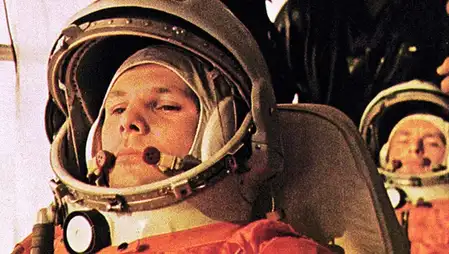
New Delhi, March 9 (IANS). The historic day of April 12, 1961, when Soviet Union cosmonaut Yuri Gagarin became the first human being to go into space. His flight added a new chapter to human history. “Poyekhaali!!” Saying (let’s go), he took off in the Vostok 1 spacecraft from Baikonur Cosmodrome in Kazakhstan.
Can humans survive in space? Is travel possible by spacecraft? Will the connection to Earth remain strong and effective? Will it be possible to return safely? Today is the birth anniversary of Yuri Gagarin, the first person to go to space to answer these questions. He proved all this possible on 12 April 1961.
This mission was the first manned space mission to complete a complete orbit around the Earth. Vostok 1 revolved around the Earth at a speed of 27,400 kilometers per hour. The entire flight lasted approximately 108 minutes. During the return the spacecraft was controlled by computers. However, the most exciting and challenging part of this mission was its landing. The then Soviet engineers did not have an adequate ‘braking system’ available for the landing of the capsule, due to which the high speed of the capsule could prove fatal when it hits the ground. In view of this risk, it was planned that Gagarin would descend safely through parachute instead of staying inside the capsule.
When Vostok-1 reached an altitude of about 23 thousand feet above the Earth’s surface, the craft’s hatch opened and Gagarin came out through the ejection seat. His parachute opened on time and after about 10 minutes of ‘descent’ (process of coming down), he was successful in landing safely on the ground.
This specific landing technique was initially kept hidden from the world by Soviet officials. According to International Aviation Federation (FAI) rules, for the world record the pilot was required to land with the craft. This was the reason why initial reports claimed that Gagarin had landed with the capsule. Years later, the fact came to light that he had resorted to parachute for safety reasons. This decision was taken for safety reasons, as the landing of the capsule was very fast and bouncy.
This successful flight made him a national hero of the Soviet Union. He became an international celebrity. Later he also became the deputy director of the Cosmonaut Training Center and trained new cosmonauts. He also completed a thesis in Aerospace Engineering. However, Soviet officials remained hesitant in sending them into space again because they were afraid of losing them. Tragically, on March 27, 1968, at the age of 34, Gagarin died in the crash of a MIG-15UTI jet during a training flight. His death shocked the entire world.
Gagarin’s legacy lives on even today. The Cosmonaut Training Center was named Gagarin Cosmonaut Training Center. Baikonur’s launch pad is called ‘Gagarin Start’, from where ISS missions are launched even today. Statues of him and American astronaut John Glenn are located side by side in Houston.
–IANS
MT/AS