West Asia is caught in a storm based on imaginary claims, the question is whether the war will give a new shape to the region, or whether it will lead to a permanent solution.
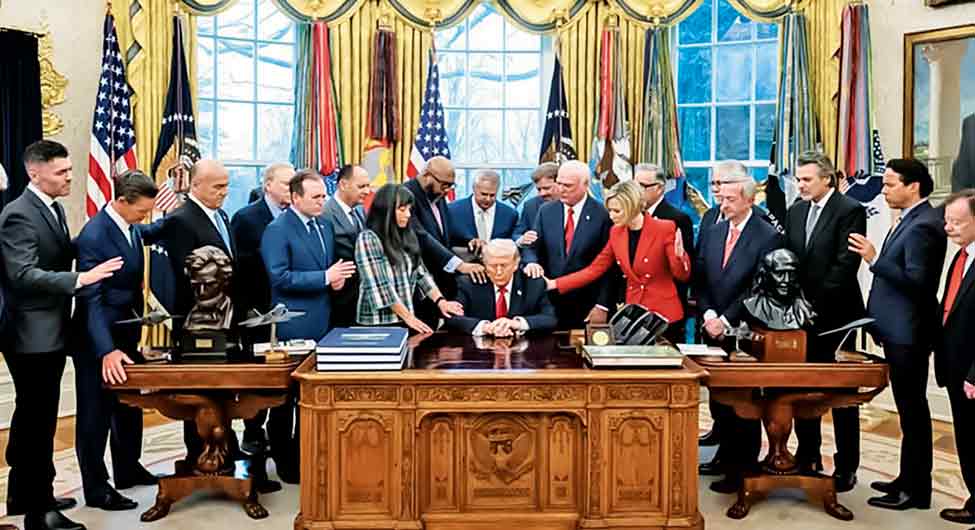
If European countries are not seen in support of US President Donald Trump and Israeli Prime Minister Benjamin Netanyahu’s latest attack on Iran, then many people may be shocked to see in Washington that they need the blessings and prayers of the clergy for Iran’s victory. Note that contrary to international rules and regulations, the argument to justify the war has been made through the claim of alleged divine order from old religious stories and narratives. From uranium enrichment to terrorism rumors against Iran are just excuses for today’s philosophy.
It is noteworthy that in Israeli and some American evangelical circles, the obsession with shaping the existing geography on the basis of Bible prophecy seems to be dominating. Israeli Finance Minister Bezalel Smotrich stands in front of a map described as “Greater Israel” in February 2023. That map includes the entire Palestine, one-third of Saudi Arabia, Jordan, parts of Lebanon, Syria, Iraq. He said, “There is no such land as Palestine because there is no such thing as a Palestinian people.” The map shows the Bible’s promised land, not any modern country or territory.
This view is also becoming a passion among American evangelical Christians. Days after meeting with his evangelical advisers, President Trump announced in December 2024 that the United States “stands ready to move forward” to assist the Iranian protests.
When former Secretary of State Mike Pompeo was asked in 2019 whether Trump had been sent by God to protect Israel, Pompeo replied, “As a Christian, I firmly believe that is possible.”
A touch of religious overtones was also visible in Israel’s “Operation Rising Lion” against Iran in June 2025. At that time, 200 jets and Mossad sabotage teams were involved and targeted more than 100 Iranian sites, including nuclear facilities. Prime Minister Netanyahu cited the Bible for the operation, referring to the “ceasing battle” against Persia and Israel’s “divine obligation” to protect the Jewish people.
This shows that things like uranium enrichment are just an excuse. The aim is to destroy Iran’s ability to challenge Israel’s dominance, end the “resistance axis” linking Tehran to Beirut and Gaza, prevent any future threat by Iran to Western interests and initiate government change.
But perhaps Iran is also a shield through which to stop the penetration of Russia and China in this area and to capture the resources here. Actually, Russia has big interests in Iran. Russia’s annual arms sales there are more than $10 billion and it is involved in atomic energy. Iran’s defeat or destruction would be a major strategic blow to Moscow. Russian bases in Syria, air defense systems in Iran, advisors in the entire region, all these together have only scope for increasing tension. Therefore, if the war escalates, Russia may have to go beyond mere diplomatic intervention.
Allah Khair Kare: Prayer in a destroyed building in Tehran amid American-Israeli attack, 4 March 2026
China is also Iran’s biggest oil customer, purchasing more than $30 billion annually. Not only this, China has an investment agreement of 400 billion dollars there, which is in the matter of infrastructure. This is necessary for the westward expansion of its Belt and Road Initiative. China’s desire to build military bases abroad also shows that it can make its presence felt in the war if necessary to save the current government of Iran. At present, he too is openly exerting pressure only at the diplomatic level. However, there are also reports that he is secretly helping Iran.
Therefore the war is not easy for Israel. Even if Israel ultimately prevails, it may have to pay a heavy price. Even without Iran’s power, Israel will remain a target all the time. Hezbollah may be weakened, but Lebanese resentment will not go away. Hamas’s funding may stop, but the Palestinians’ desire for their own country will not end. New fronts of war will continue to open.
After 1945, Europe avoided war not through military dominance but through international rules and regulations. West Asia also needs a similar framework. Such as, economic system based on mutual dependence, security arrangements to settle disputes and mutual cooperation to jointly respond to external interference, etc.
We should learn from history. The Mongol invasions, the Crusades, the colonial period, the post-2003 turmoil, all teach the same lesson, regional fragmentation enables external dominance; Internal conflicts become tools for external manipulation.
West Asia today stands at the crossroads. One path leads to conflict with Iran, justified by uranium enrichment, viewed from a religious perspective, and a divine mandate for military attack.
This option could lead to disaster. There is very little idea of what will happen after that, but it could be very bad. Fragmentation of Iran or Israel, displacement of millions of people, proxy war in many countries, economic shocks across the world due to interruption in oil supply, terrorists can take advantage of this chaos and intervention of Turkey, Russia and China can fill this void.
West Asia is caught in such a storm. The question is not whether war can reshape this region. The question is whether this area can survive this change and remain the same as before. Whichever way the situation turns, the balance of power in West Asia will never be the same.
(The author is an expert on West Asia affairs and a senior journalist. Views are personal)