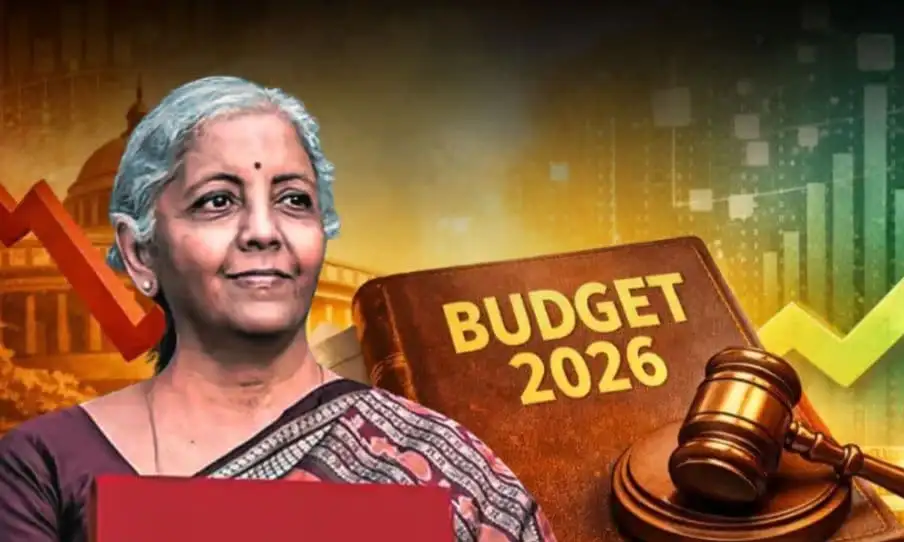
Finance Minister Nirmala Sitharaman can make 5 big announcements in the budget on 1st February…
1. Income Tax: Income up to Rs 13 lakh can be tax-free
In the new income tax regime, the standard deduction can be increased from Rs 75,000 to Rs 1 lakh. With this, income of salary earners up to Rs 13 lakh will become tax-free. Currently, income up to Rs 12.75 lakh is tax-free.
Why this announcement could happen:
Industry body Confederation of Indian Industry (CII) has suggested to the government that it is necessary to leave more money in the hands of people to increase consumption. Increasing tax exemption will increase the purchasing power of people, which will benefit the economy.
The government wants to replace the old tax regime with a new tax regime. For this, it is important to keep the new tax regime attractive. For this purpose, standard deduction can be increased for people getting salary in the new regime.
Benefit: The amount of money in the hands of middle class people will increase. They can save a few thousand rupees every month. It can be used for spending, saving or investment.
2. Kisan Samman Nidhi: Annual amount may increase by 50%
Under the PM-Kisan scheme, the annual amount can be increased from Rs 6,000 to Rs 9,000. There is talk of increasing it for the last 3 years.
Why this announcement could happen:
There has been no change in the scheme since its launch in 2019. In 2024, the Parliamentary Standing Committee had recommended doubling the annual amount to Rs 12,000.
Farmers’ organizations say that the value of Rs 6,000 received since 2019 has reduced to Rs 5,000 due to inflation. It should be increased to Rs 12,000.
In November 2025, the Bihar government had announced to provide an additional Rs 3,000. With this, the farmers there will get a total of Rs 9,000. The central government can implement it all over India.
Expenditure calculation: Currently about 11 crore people are getting Kisan Samman Nidhi. The central government spends Rs 60,000 to 65,000 crore annually on this. Increasing it to Rs 9,000 annually will increase the expenditure to approximately Rs 95,000 crore per year.
Benefit: About 11 crore farmer families of the country will benefit from this. The additional Rs 3,000 will help farmers meet minor farming needs.
3. Rail Infrastructure: 300+ new Amrit Bharat and Vande Bharat trains
The government wants to eliminate the train reservation waiting list by 2030 by starting new trains. More than 300 Amrit Bharat and Vande Bharat trains are expected to be announced.
In the last budget, Rs 2.65 lakh crore was allocated for Railways. This was the largest rail fund ever. This time too it is expected to increase.
Why this announcement is likely to happen:
The government aims to eliminate waiting lists for train reservations by 2030. At present, there is a gap of about 20-25% between demand and availability of seats during the peak season. For this, there will be a need to increase the number of trains and expand the tracks.
Benefit: About 2 crore people traveling by train daily will benefit from this.
4. PM Surya Ghar Yojana: Subsidy of ₹80,000 on 2 KW solar panel
There may be an announcement in the budget to increase the subsidy on solar systems up to 2 kilowatt (KW) from Rs 30,000 per kilowatt to Rs 40,000.
According to the current rules, for installing a 2 KW solar system, a total subsidy of Rs 60,000 is available at the rate of Rs 30,000 per kilowatt.
If the subsidy is increased by Rs 10,000 per kilowatt in the budget, then a total subsidy of Rs 80,000 will be available on a 2 KW solar system. That means there will be a saving of Rs 20,000.
The subsidy for 2 to 3 KW systems is Rs 18,000 per KW. For systems above 3 KW, the subsidy is limited to Rs 78,000. Why this announcement is likely to happen:
The central government aims to connect 40 lakh homes to the solar grid by March 2026 and 1 crore homes by 2027. This scheme will help the government to achieve its target faster. By December 2025, more than 19.45 lakh panels had already been installed.
Benefit: The increased subsidy will directly result in additional savings of ₹20,000 to households installing 2 KW systems. This will not only provide free electricity to the families, but they will also be able to earn money by selling the remaining electricity to the grid.
5. Ayushman Bharat: Benefits for all senior citizens above 60 years of age
The government can increase the scope of Ayushman Bharat (PM-JAY) scheme. Currently, the benefit of this scheme is available to senior citizens above 70 years of age, but this age limit can be reduced to 60 years. Additionally, the annual limit for free treatment, which is currently ₹5 lakh, may be increased to cover the cost of treatment of critical illnesses like cancer and heart surgery.
Why this announcement may be made:
According to a report by Outlook, 82% of senior citizens in India aged 60 years and above do not have any health insurance. While people above 70 years of age are covered under Ayushman Bharat, senior citizens between 60 and 70 years of age who do not have health insurance have to spend their savings for the treatment of critical illnesses. The government can provide relief to this group.
Benefits: By reducing the age limit to 60 years, lakhs of new families will come under this scheme. By increasing the treatment limit, families will not have to take loans for major surgeries. Patients will be able to get free treatment even in big and specialized hospitals.