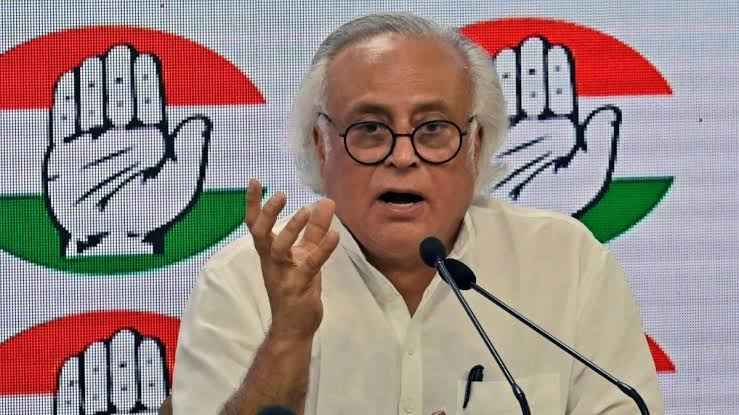
Congress leader Jairam Ramesh demanded that the central government immediately stop the India-US interim trade framework after the US Supreme Court’s tariff decision.
Briefing reporters here, Ramesh said, “We demand that in view of the Supreme Court’s decision on tariffs, the Modi government should immediately put the India-US interim agreement framework on hold. The agreement should be reconsidered to end agricultural import liberalization using the provision given in the joint statement.”
Earlier in the day, Ramesh hit out at Prime Minister Narendra Modi over the timing of the announcement of the India-US trade deal on February 2, calling it desperation and an attempt to divert political attention.
In a post on his
Ramesh wrote, “Yesterday, after the US Supreme Court struck down his tariff policy, President Trump announced that (i) Mr. Modi is his close friend; (ii) the India-US trade agreement will continue in place; (iii) he had personally stopped Operation Vermilion on May 10, 2025, threatening to increase tariffs on Indian exports to the US if India did not stop Operation Vermilion.”
He wrote, “On February 2, 2026, President Trump first announced that the India-US agreement had been finalized and said that ‘out of friendship and respect for Prime Minister Modi, and at his request, effective immediately, we have agreed to a trade agreement between the United States and India.’
He further asked, “Who forced Prime Minister Modi to get President Trump to announce the India-US trade agreement on the night of February 2, 2026 (Indian time)? What happened in the Lok Sabha that afternoon that made Modi so desperate and tried to divert attention by contacting his good friend in the White House?”
The Congress leader alleged that if the government had waited 18 more days for the US Supreme Court’s decision, Indian farmers and national interests could have been protected. “The India-US trade deal is indeed a test that India is facing because of the Prime Minister’s desperation and capitulation,” he said.
The background of this dispute lies in the agreement reached on February 2 under which India had agreed to reduce the duty on exports to the US from 50% to 18%.
However, the US Supreme Court later struck down the reciprocal tariffs imposed by Trump under the International Emergency Economic Powers Act (IEEPA), ruling that the law does not provide unilateral authority to impose blanket tariffs.
Although the emergency rate of 50% was declared invalid, President Trump invoked Section 122 of the Trade Act of 1974 to temporarily impose a global tariff of 10% for 150 days. Any imposition of duty higher than this may require national security or unfair trade investigation action under Section 232 or 301.