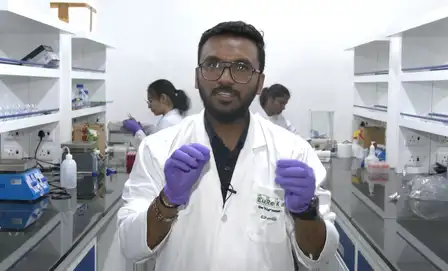
Gandhinagar, April 19 (IANS). Harshil Dave, a young scientist from Mehsana, has achieved great achievement in the field of medical science. Harshil, a research scholar at IIT Gandhinagar, has developed a hydrogel-based technology that can make colon tumor surgery safer and easier. This hydrogel-based technology helps in the surgery of colorectal polyps, i.e. tumors that are likely to turn into cancer.
Research scholar Harshil told that this hydrogel made by us has a special shear-thinning property, which means that when pressure or force is applied on it, it becomes liquid and then when the force is removed, it turns back into solid (gel) form. Because of this property, doctors can easily inject it through a long catheter or endoscope. After injection, the substance forms a cushion beneath the tumor, which helps the doctor lift the tissue more easily and remove it with greater accuracy.
Usually, during endoscopic surgery, saline or dextrose is poured under the colon tumor, so that the tumor can emerge, but this liquid quickly disappears. With this new hydrogel based technology, the tumor becomes solid, which makes surgery easier.
Mukesh Danka, Assistant Professor, Biological Sciences and Engineering Department, IIT Gandhinagar, said that Harshil Dave is a PhD student of my lab. Harshil started its search three years ago. We ordered DGMS molecule from the plant. We checked its properties by putting it in water and saw that it was producing nano fibrous hydrogen. Harshil started work on it. We saw that when we apply force of injection, it becomes liquid and as soon as we inject it into the body, it becomes solid.
He told that small cancerous tumors develop in our GIT track. We thought that we could inject it through endoscopy and it could be useful in removing those tumors surgically. Many medicines can be loaded into this molecule. This technology is injectable hydrogel technology for endoscopy.
Let us tell you that this research of Harshil Dave has been published in a reputed international journal, and he has also been honored with ‘Vikram Sarabhai Young Scientist Award 2026’ for this research. At present, this technology has been successfully tested in pre-clinical trials and on large animals, and it has also received an Indian patent. Now preparations are being made to take this technology to clinical trials, so that in future it can be widely used in the treatment of colon cancer.
–IANS
sd/as