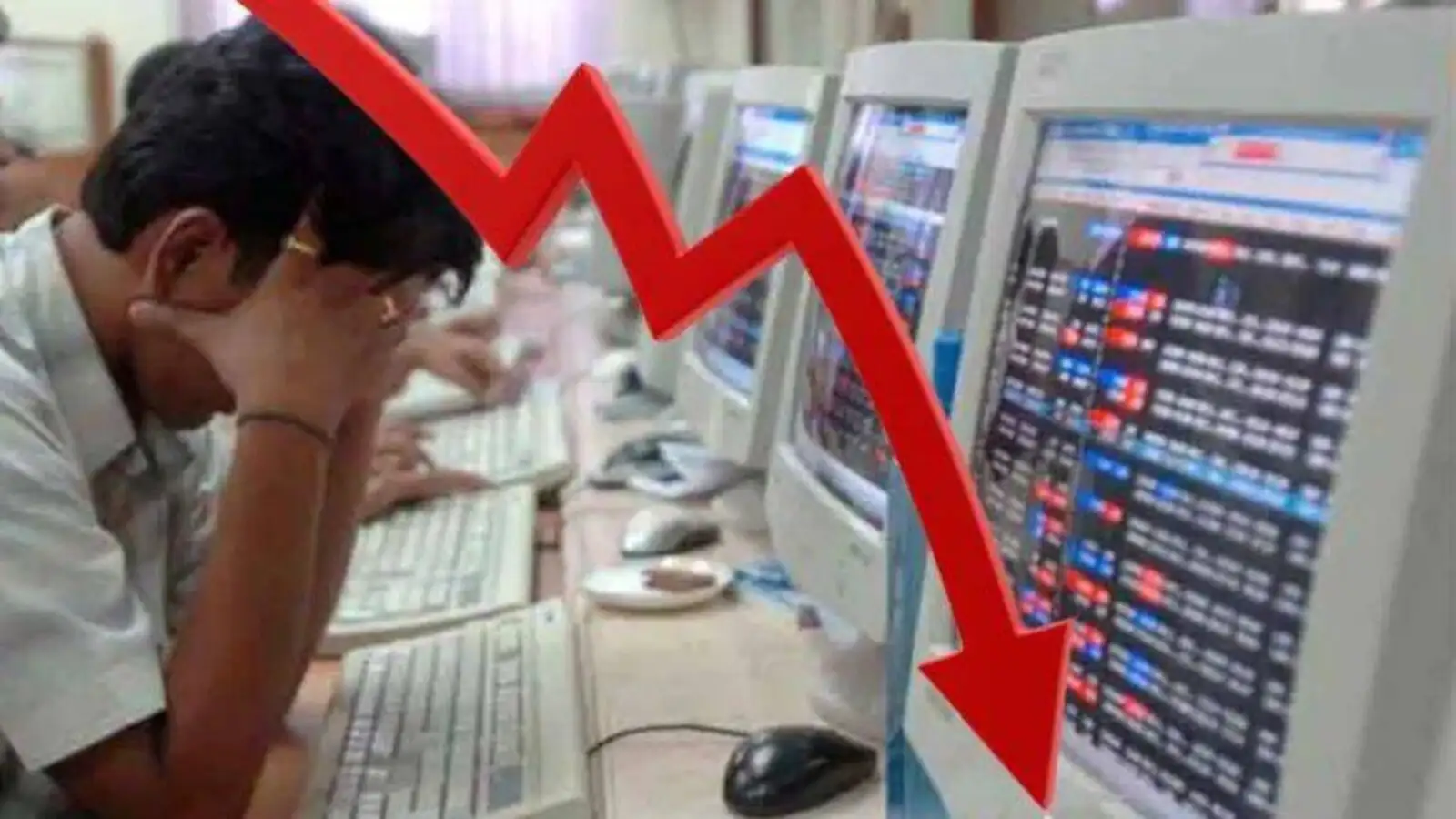
There was a huge fall in the Indian stock markets on Tuesday. Sensex and Nifty fell by about 2 percent each, further increasing the losses. The decline was due to a strengthening rupee, rising oil prices and other factors that weakened investor confidence. Sensex fell by more than 1,456 points to close at 74,559, while Nifty fell by more than 436 points to 23,379. This came as the India VIX – an index that measures market volatility – rose 4 per cent to 19.26. The decline resulted in a loss of more than ₹10 lakh crore from the total market capitalization of all BSE listed companies, leaving the total market capitalization at ₹457 lakh crore.
Huge fall in these shares
IT stocks like Tech Mahindra, HCL Tech, TCS and Infosys were among the biggest fallers in the Sensex. These shares declined 3-4 per cent as new launches by OpenAI rekindled concerns over the disruptive impact of AI. Shares of Adani Ports and Titan also fell by about 4 per cent each and joined the list of biggest fallers along with the IT giants. Contrary to this trend, shares of NTPC, SBI and Bharti Airtel closed in the green with slight gains.
There was an atmosphere of recession everywhere in the market. The Nifty Smallcap 100 and Nifty Midcap 100 indices declined 2.5-3 per cent, underperforming the benchmark indices. Sector-wise, Nifty IT and Nifty Realty indices were the worst performing indices, falling around 4 per cent each, while all other sectoral indices closed in the red. On the NSE, about 2,726 shares declined, 590 shares advanced and 65 shares remained unchanged.
What do experts say?
Vinod Nair, head of research at Geojit Investments, said domestic equity markets appear to be under pressure. This was attributed to the rupee reaching a record low, rising crude oil prices due to rising tensions in the Middle East and capital outflows by foreign institutional investors (FIIs). He said the decline was widespread, with IT and realty stocks falling the most. He further said that IT stocks performed below expectations as concerns grew about price pressures arising from AI and potential changes following OpenAI’s recent launch of new enterprise initiatives.
What will happen next?
It seems that investors are waiting for the upcoming domestic CPI data to assess the possible impact of the ongoing conflict between the US and Iran. The analyst further said that due to concerns over crude oil and currency fluctuations, the market mood is likely to remain volatile in the near future. If geopolitical tensions ease, the market may see a cushioned rally, underpinned by strong domestic fundamentals and stable institutional investment.