All living beings including human beings are mere travelers in the inter-relationship between body and soul and the endless journey of this inter-relationship, the beginning of whose resting place is Pratyahara. The senses and the mind are two such parts of the human being, which determine the personality of the human being, his activities, his emotions or in short, his entire personality. The senses and mind are active. Both of these provide nourishment to man. It is necessary to control both of these. For this, control of senses and control of mind are considered essential. The practice of pratyahara is a perfect example of this. It controls the senses and mind and by keeping them free from distracting sensual desires, it helps in keeping the flow of human energy in the right direction. There is no wastage of human energy. This arrangement is mandatory and required for the inner journey.
mystery of man and god
It is written in Brahmabindu Upanishad (2) ‘Man and human beings are the causes of bondage. Bandhay Vishyasaktaah Muktayai Nirvishayam Smritaam. That is, mind is the cause of bondage and salvation of all human beings. A mind attached to objects is said to be the cause of bondage and a mind devoid of desires and resolutions is said to be the cause of salvation or liberation. It is Pratyahar that inspires man to move towards the door of liberation by becoming a follower of this path and this is the beginning of the inner journey. Glory comes with man, because God is hidden deep behind man. Man cannot live without temples, cannot live without churches, mosques, because man himself is a temple. Man is full of devotion towards his God. Man cannot live without God, because deep down he is God himself. There is a bridge between man and God – between matter and mind, between this world and that world, between the transitory and the eternal, between life and death. This is also the beauty – of the mystery between man and God, the contradiction arising between them. Therefore, man is not a puzzle, but man is a mystery. Pratyahara is the discovery of this mystery, which is the beginning of the journey into the inner self.
practice of withdrawal
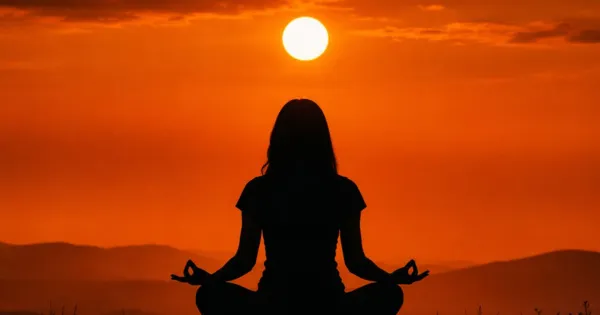
Pratyahara comes before the fifth limb of yoga, ‘Dharana’, which means the practice of turning or concentrating one’s fickle senses (eyes, ears, tongue, etc.) away from external objects (forms, tastes, smells, etc.) towards the mind and soul. When the eyes stop seeing, the ears stop hearing and the mind concentrates on a single point, this is the practice of pratyahara, which leads to meditation. Pratyahara means turning the senses inward from external objects, which is the fifth stage of Ashtanga Yoga, it is the beginning of the inner journey, where the mind becomes free from the influences of the external world and starts concentrating within itself, paving the way for higher yogic stages like Dharana, Dhyana and Samadhi. It is the process of establishing control over the senses and diverting them from objects, so that the person can concentrate his inner energy.
The meaning of internal journey is – my body, my mind, my senses, my intelligence and mind i.e. gross, subtle and causal – all three bodies are engrossed in the subjects of this world, the glamor of the world, attachment-hatred, violence-hatred, strife-tribulation, attachment-love etc., then how can we remove these three bodies from these evils and direct them towards goodness, charity and charity – only, to prove this, whatever means are available. What is adopted is Pratyahar. Developing within oneself the nature of renunciation towards worldly objects and subjects is also the practice of Pratyahara. This is possible by adopting contentment. Maharishi Patanjali has described satisfaction as the ultimate happiness – “Santoshada Anuttam ॑ Sukh Labh:”. The happiness derived from sacrifice is greater than that of accumulation. Even after earning a lot of money, one does not get the happiness that one gets by giving a little money to a real needy person. The first verse of Ishopanishad teaches – “Tentyakten Bhunjitha” i.e. enjoy with sacrifice. This is the practice of pratyahara.
focus one’s mind
Maharishi Patanjali explains in the 54th sutra of Sadhanapada of Yoga Sutra – “Svavishya Samprayoge Chittasya Swaroopanukar Ivandriyanam Gratyahar:” That is, during the period of Sadhana, the seeker abandons the objects of the senses and concentrates his mind on the goal. At that time, the senses do not go towards their objects and get merged in the mind, this is Pratyahar and when the Pratyahar is accomplished, the senses of the seeker become completely under its control. “Tatah Paramavasyat Indriyanam.” Sutras for the practice of Pratyahara: Self-contemplation, self-observation, living consciously. This is the beginning of the journey into the heart of man. Pratyahara is the process of knowing man from within. There is no way to know a person from outside. If you try to know man from outside, as scientists do, we will make mistakes. The only way to know a man is to know the man who is within us. The only way to know a person directly is to interview oneself and this is possible through Pratyahara. We carry a huge power within us, unless we identify with it, we will not be able to see or recognize it outside in others. This has to be taken into consideration as a criterion that the more we know ourselves, the more we can know others. Not an iota more than that. Absolutely not – this is impossible. First one has to know the one who knows, only then one can delve into the mystery of the other. We have to first delve into our own depth, only then our eyes are able to recognize the depth of others.
Osho has said, “If you live on your periphery, the whole existence will seem shallow. If you think that you are a wave of the ocean, and you have no acquaintance with the ocean, then the rest of the waves will also remain waves. When you descend within yourself and know that you are the ocean, you have always been the ocean, you just have to know, then all the other waves also disappear, now only the ocean is waving. Now behind every wave there are beautiful or ugly, small or Well, it doesn’t matter, behind every wave the ocean waves.”