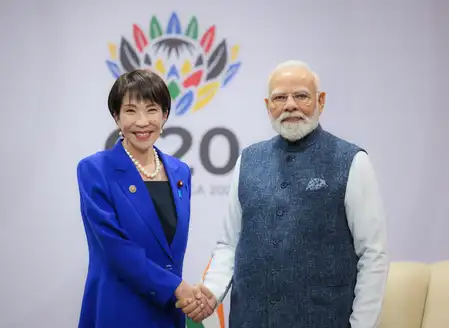
New Delhi, July 1 (IANS). India’s maritime vision has now transformed into a mega-led approach. It started with the vision of ‘security and development for all in the region’ (SAGAR) and has now grown to ‘mutual and inclusive progress for security and development across regions’ (SAGAR). This thinking also aligns with Japan’s ‘Free and Open Indo-Pacific’ (FOIP) framework, as stated by Japanese Prime Minister Sanae Takaichi herself in a recent article.
Together, these initiatives by the Prime Ministers of the two countries reflect a democratic partnership in the Indo-Pacific region that combines development with security and an inclusive approach with a strong counter-capability.
In today’s uncertain world, India and Japan are confident that their common vision will not only strengthen maritime security but will also help the countries of the Global South to choose their own path and move forward.
Prime Minister Narendra Modi first put forward the idea of ’SAGAR’ in March 2015 regarding India’s policy for the Indian Ocean Region (IOR). This was the occasion when they inducted Offshore Patrol Vessel Barracuda built by Garden Reach Shipbuilders of Kolkata in Mauritius.
The objective of ‘SAGAR’ was to maintain peace, stability and prosperity in the Indian Ocean region.
Prime Minister Modi had described ‘SAGAR’ as India’s responsibility in which India will play the role of a ‘trusted security partner’ and promote trust, transparency and peaceful resolution of disputes in maritime matters.
Ten years later, in March 2025, when Prime Minister Modi again visited Mauritius, he launched ‘Mahasagar’. This is an extension of the earlier vision, in which India does not want to be limited to just the Indian Ocean, but wants to play a leadership role for the countries of the Global South.
‘Mahasagar’ takes forward such thinking which gives importance to development, trade and environmental sustainability along with security.
Interestingly, in many languages of India, ‘Sagar’ means sea, while ‘Mahasagar’ means big sea.
The use of this name shows that India’s thinking is no longer limited to the Indian Ocean region, but is moving towards a broader global maritime perspective. In this, special focus is on the countries of the Global South, as India’s former Ambassador to Thailand Suchitra Durai had said earlier.
According to him, Prime Minister Modi’s talks and visits with countries like Mauritius, Maldives, Trinidad and Tobago, Ghana and Philippines are linked to the thinking of ‘Ocean’.
At the same time, in the article of Prime Minister Sanae Takaichi, his thinking of ‘FOIP’ (Free and Open Indo-Pacific) has been linked with the initiative of Prime Minister Narendra Modi.
According to Takaichi, a truly free and open region is not one where only big countries get freedom, but should be such a region where every country can choose its own path without any external pressure.
He described India as a very important partner and said that India is a maritime country which has taken concrete steps to maintain regional stability and strengthen the surrounding countries.
It is clear from his words that there is similarity in the thinking of both the countries. While Japan’s FOIP policy emphasizes the rule of law and freedom of navigation at sea, India’s ‘ocean’ approach also adds a development aspect to it.
Together, these two initiatives offer a democratic alternative to China’s Belt and Road Initiative (BRI) and its ‘String of Pearls’ strategy in the Indian Ocean.
The Indo-Pacific region has become an important strategic region of the 21st century. Be it China’s military activities in the South China Sea or its growing influence through infrastructure in South Asia, this has increased concern among smaller countries.
Even an influential country like America is resetting its responsibilities and policies according to the new circumstances. At such a time, there is an opportunity for middle level powers like India and Japan to come forward.
For India, ‘Ocean’ will help in establishing it as a responsible power, where the focus will be on the strength of security as well as the strength of cooperation and trust. For Japan, ‘FOIP’ ensures that democratic values and freedom of sea lanes remain an important part of the regional order.
For the entire Global South, ‘Ocean’ and ‘FOIP’ offer an option for partnership and taking one’s own decisions rather than dependence on China.
The history of friendship between India and Japan is very old, in which cultural and civilizational ties have played a strong role.
In recent years this relationship has grown into a strong and purposeful partnership.
The two countries’ relations at the regional and international level include initiatives such as the Asia-Africa Growth Corridor (AAGR) and arrangements such as the Quadrilateral Security Dialogue (Quad) in the field of defense cooperation, which also includes the US and Australia.
Under ‘AAGR’, India and Japan are already working together on projects in Bangladesh, Myanmar, Sri Lanka and some African countries.
As Japan’s ‘FOIP’ and India’s ‘Ocean’ thinking are coming closer to each other, a new path of cooperation may emerge in the Indo-Pacific region. A path that includes development with security and the idea of taking everyone along with a strong security system.
In today’s world full of uncertainty, India hopes that its comprehensive thinking will not only strengthen maritime security but will also win the trust of the countries of the Global South.
–IANS
AY/DKP