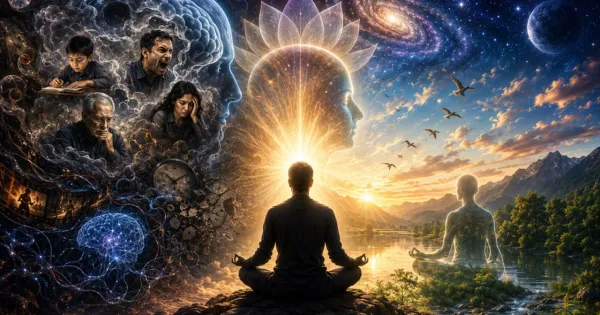
Man’s biggest illusion is that he considers himself to be only that which keeps changing, like body, emotions or thoughts. When we accept change as our identity, suffering becomes our destiny, whereas the truth is that we are not the body, not the mind and not even the emotions. In reality we are the consciousness which is observing all this.
Consciousness is pure awareness that makes us aware of the existence of something, while mind is a flow of thoughts, memories and emotions that are experienced through this consciousness. Thus consciousness is stable and eternal, while mind keeps changing from moment to moment. Your mind was different in childhood and is different in old age, but your conscious sense of self is always the same.
If mind is all that is experienced, then consciousness is all that is experienced. This immutable element is consciousness. The mind keeps changing continuously, but the one who is aware of this change does not change. If the mind is the material of a film, then consciousness is the screen on which the film plays. This can be understood like this, when you sit in a theater and watch a movie, sometimes there are scenes of love, sometimes laughter and sometimes sadness or fire and violence on the screen, but does the curtain burn and burst, does the curtain sometimes cry or laugh.
In reality the curtain is only a basis for seeing. Similarly, our inner consciousness is also like a curtain. Emotions and thoughts come and go like a film, but we are hurt or injured by them only when we understand ourselves to be a film. Similarly, clouds come and go in the sky. Sometimes black-brown or white, but do they have any effect on the sky, no. Similarly, no emotion ever leaves a permanent impression on the consciousness.
Regarding mind and consciousness, philosophers say that it depends on your definition. According to him, mind is that part which is not yours, it is like a given thing. In this way, mind means that which has been created, which has been filled within you by the society, even though it is not you. Consciousness is your nature, mind is just a periphery, which has been created as a periphery around you by society, by your culture or education. Mind means culture.
In this sequence, Acharya Rajneesh says that you can have a Hindu mind, but you cannot have a Hindu consciousness. You can have a Christian mind, but you cannot have a Christian consciousness. Consciousness is one, it cannot be divided.
Neuroscience experiments (like Libet’s experiment) show that your subconscious mind has already made the decision before you do. You just get this illusion later that ‘I took this decision’. Similarly, we think that our ‘I’ or ‘ego’ is a single entity, but different parts of the brain (memories, emotions, visuals) work separately and ultimately weave a story to make you feel ‘one’.
Scientists can understand how the brain’s neurons send signals, but how physical neurons work together to produce an ‘intrinsic lived experience’ or emotion (such as how it feels to see the color red) is still an unsolved mystery to science. In contrast, Indian philosophies such as Advaita Vedanta and Buddhism have held for thousands of years that the mind and thoughts are constantly changing, so they are not permanent truth but an illusion (maya). True consciousness is the witness which sees this entire illusion without being attached. This has been clearly explained in Bhagavad Gita and Indian philosophy.