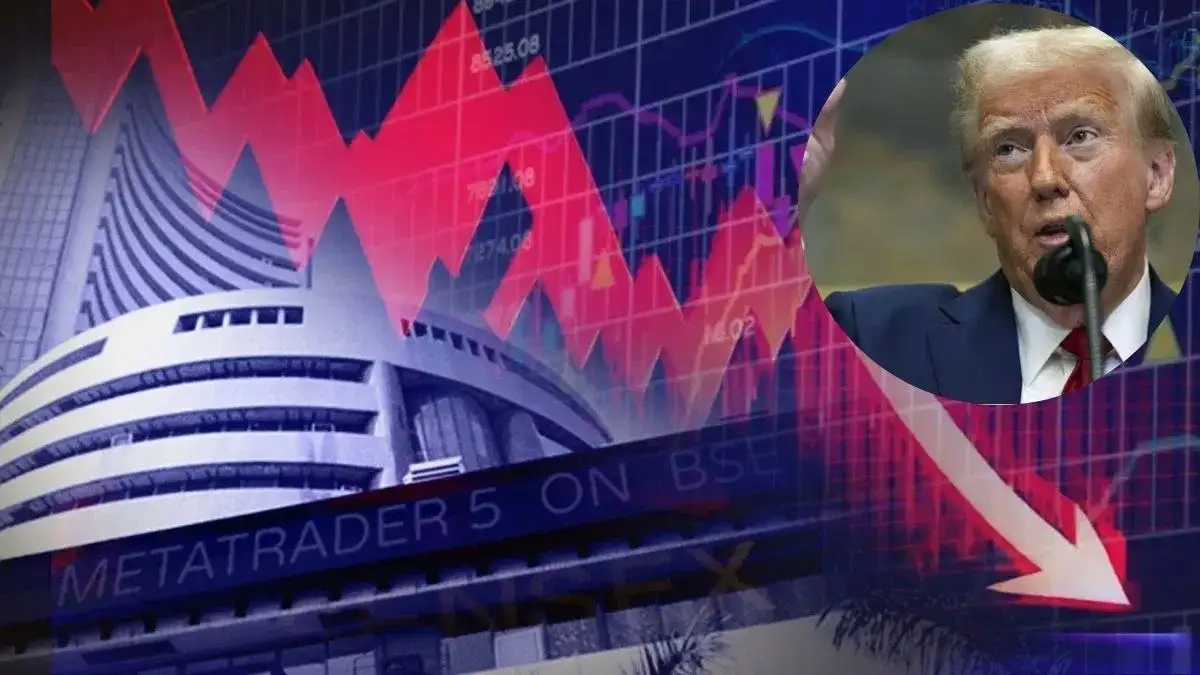
The Indian stock market has been under continuous pressure for the last five trading sessions. Increasing uncertainty regarding global trade, political developments in Washington and geopolitical tensions have weakened the risk appetite of investors. As a result, the BSE Sensex has fallen more than 2,100 points in the last five days. While the Sensex had closed at 85,762.01 on January 2, it fell to 83,506.79 during intraday trading on Friday. Similarly, Nifty also came under pressure and fell below 25,700.
1. Heavy selling by foreign investors
The biggest reason for this decline has been heavy selling by foreign investors. Amid global uncertainty and trend of capital flight from emerging markets, Foreign Institutional Investors (FIIs) sold shares worth Rs 3,367.12 crore on January 8 alone. Due to this continuous capital outflow, the sentiment of domestic investors has also weakened, due to which the pressure on the market has increased further.
2. Trump’s trade and tariff uncertainty
Another big reason is US President Donald Trump’s uncertain rhetoric regarding trade and tariffs. Investors have been worried about warnings to take a tough stance against many countries, including India, for buying cheaper crude oil from Russia. There is talk of a new bill in America that could impose a tariff of up to 500 percent on countries buying oil from Russia. Such apprehensions have created an atmosphere of fear in the global markets including the Indian stock market.
3. Lack of concrete results in India-US trade talks
Apart from this, lack of concrete results in India-US trade talks is also an important reason for the market weakness. Despite nearly six rounds of talks since March, no concrete agreement has been reached between the two countries. The Trump administration has already imposed a total tariff of 50 percent on India, which includes 25 percent base tariff and 25 percent penalty. India had called it unfair, but the lack of resolution continues to worry investors.
4. Tension on oil prices
The increasing tension regarding oil prices has also proved negative for the market. Investors are closely following developments in Venezuela due to uncertainty over cheap oil supplies from Russia and India’s heavy dependence on imports. The rise in crude oil prices has raised concerns about inflation and rising current account deficit, posing a threat to the stock market.
5. Falling rupee
Amidst all this, the weakening Indian rupee has further increased investors’ concerns. After falling nearly 4 per cent last year, the rupee has now crossed the 91 level against the dollar. Despite limited intervention by the Reserve Bank of India, the continued depreciation of the currency has raised questions about foreign capital flows and market stability. For all these reasons, the Indian stock market is currently under pressure, and investors are adopting a cautious approach.