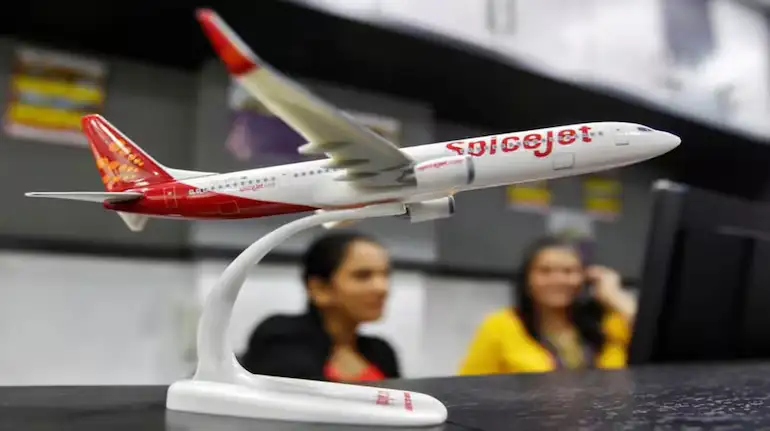
The country’s private airline, SpiceJet, is facing a serious crisis. Due to reduced operational efficiency, the company has decided to reduce its staff by 20%; The move could send more than 500 employees on leave without pay. Currently 6,800 employees are working in the airline. It now has only 13 of its own aircraft left—including 10 Boeing jets and 3 Q400s—while another 14 aircraft are operated under wet-lease agreements (including crew). Senior officers have not received salaries since January, while other employees are facing a delay of 2–3 months in getting their salaries. The company has outstanding dues of over ₹100 crore relating to GST, TDS and PF contributions. TDS payment has not been deposited since April 2025, and GST payment is outstanding for the last five months.
Losing market share to Akasa
The airline has waived the three-month notice period of dozens of engineers who had resigned. Following an order issued on March 31, these employees have been directed to leave their jobs with immediate effect. SpiceJet’s share in the domestic market has fallen to just 3.9%. In comparison, a relatively new airline, Akasa—which has a fleet of 37 aircraft and a team of 5,000 employees—has a market share of 4.9%. Employees working for a long time are also expressing dissatisfaction over not receiving their full and final settlement dues.
Pilots’ salaries reduced; Work limited to 21 days
A new policy has been implemented for pilots. Under the new rules, they will have to work for 21 days and take 9 days off. As a result, the captain’s monthly salary will reduce from ₹7.5 lakh to ₹6 lakh.
Airline’s loss widens to ₹621 crore in July-September quarter
Low-cost airline SpiceJet’s consolidated net loss widened 35% year-on-year to ₹621 crore during the July–September quarter (Q2FY26). In the same quarter last year, this figure was ₹458 crore. The company’s operational revenue also fell 13% to ₹792 crore. In the same quarter last year, this figure was ₹915 crore.
Three reasons for SpiceJet’s increasing losses
Rising operational costs: Fleet revival involves repairs to older aircraft—such as engine repairs and replacement parts. In the second quarter (Q2), SpiceJet grounded several aircraft (out of service), incurring expenses of ₹297 crore. Expansion efforts (adding new flights) also increased costs, as capital was invested in purchasing or leasing new aircraft. As a result, total operational costs (running expenses) increased by 13% year-on-year (YoY). The company says that while this may be difficult in the short term, it will result in a stronger fleet in the long run.
weak ‘lean-season’ demand; Decline in passenger traffic during monsoon: “Lean-season demand” refers to the lower volume of travel that is typically seen during the monsoon season (July-September). There is less travel activity during this period as this is the time of rainy season and relatively less holidays. SpiceJet reported revenue of ₹792 crore—a decline of 13% compared to ₹915 crore reported last year. On a quarter-on-quarter (QoQ) basis, revenues declined 29%, reflecting the higher demand levels seen in the first quarter (Q1). Although passenger load factor stood at 84.3%, overall ticket sales declined. This resulted in reduction in earnings and further increased the losses. The company has expressed hope that the situation will improve from the third quarter (Q3), which will start with the festive season.
Supply chain disruptions: Supply chain issues mean shortages of aircraft parts and engines. Many SpiceJet aircraft remained grounded due to delays in engine overhaul. Delivery of spare parts was delayed due to disruptions in the global supply chain—such as shipping delays. This led to a reduction in flight operations and an increase in operational expenses. The operational loss of ₹297 crore recorded in the second quarter (Q2) was mainly due to these reasons. The company has reported that its fleet is expected to be fully operational by Q3; However, these supply chain problems still remain a major cause of its financial losses.
SpiceJet: India’s low-cost airline
SpiceJet is an Indian low-cost airline that connects the most remote corners of the country. The company operates around 250 flights daily to 48 domestic destinations within India and several international destinations. SpiceJet’s fleet includes Boeing 737 MAX, Boeing 700 and Q400 aircraft. The SpiceJet brand was launched in 2004, but its Air Operator Certificate (AOC) dates back to 1993. At that time, S.K. An air taxi company owned by Modi had partnered with German airline, Lufthansa. Its operations were suspended in 1996. In 2004, entrepreneur Ajay Singh planned to establish SpiceJet as India’s low-cost airline. SpiceJet’s first flight took off from New Delhi (DEL).