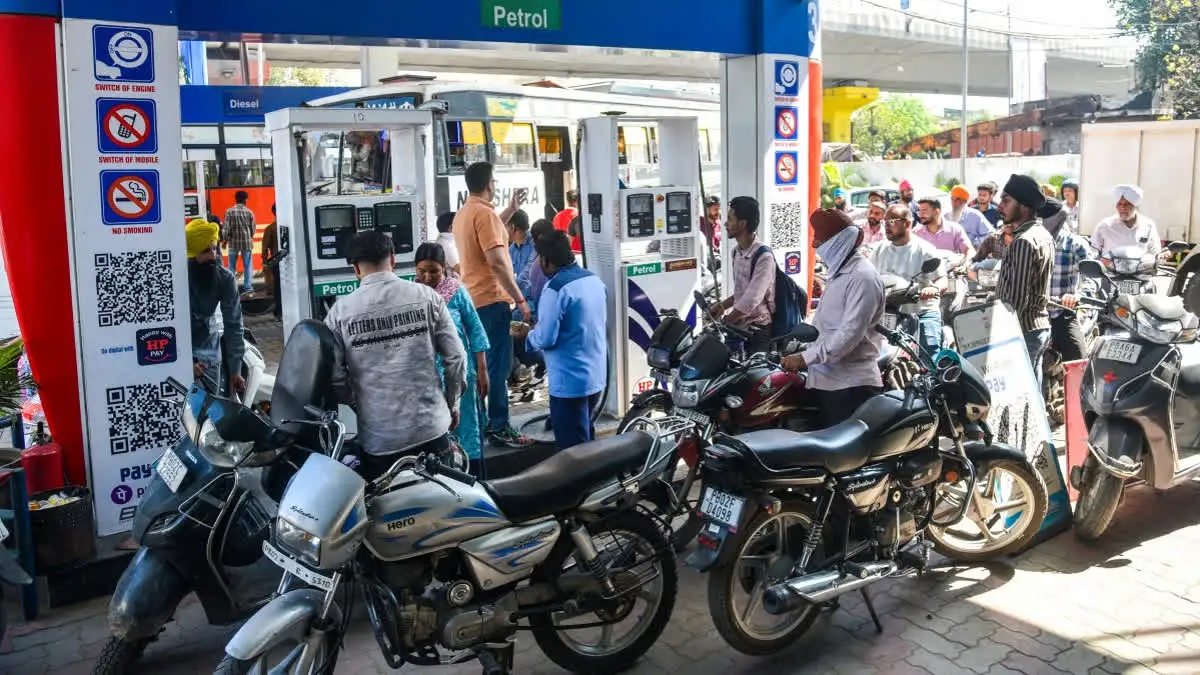
After US President Donald Trump announced the deal with Iran, the world is hopeful that the energy supply chain will become normal. Trump has announced that an agreement has been finalized to end the dispute between America and Iran. The peace agreement will be signed in Switzerland on 19 June. Prime Minister Narendra Modi has welcomed this peace agreement. Meanwhile, after this agreement, India’s Ministry of Petroleum and Natural Gas has issued a statement assuring that there is no shortage of petrol or diesel in the country.
**India’s statement on LPG, petrol and diesel**
Sujata Sharma, Joint Secretary, Ministry of Petroleum and Natural Gas, said, “The supply of petrol, diesel and LPG in the country remains stable. Refineries are operating at full capacity and adequate stocks of crude oil are being maintained. However, sales at some retail outlets are unusually high. This is mainly because industrial, direct, institutional and commercial customers are now buying fuel from retail outlets, leading to increased sales there.”
**Strait of Hormuz will be opened toll-free: Trump**
In a post on Twitter, Trump said that an agreement has been reached with Iran under which the Strait of Hormuz will be opened toll-free. He has also issued orders to lift the naval blockade. The agreement between the US and Iran to end the 107-day standoff and reopen the Strait of Hormuz is expected to provide relief to the Indian economy on multiple fronts. This agreement is likely to boost India’s exports to West Asia, accelerate manufacturing activities and stabilize the rupee.
**Decline in imports from Gulf countries**
The standoff has disrupted global energy supplies, pushed crude oil prices above $100 a barrel and brought the entire West Asian region to the brink of major conflict. The standoff began on February 28, when the US and Israel launched military operations targeting Iran’s nuclear program. Its impact on India’s exports was clearly seen. In March, the country’s exports fell 7.44 percent to $38.92 billion, the biggest decline in five months. According to news agency PTI report, imports from Gulf countries also declined by 51.64 percent during this period. India’s total trade with GCC
India’s total trade with the Gulf Cooperation Council (GCC) is mixed. In 2024-25, India’s exports are expected to grow by nearly one per cent to $57 billion, while imports are expected to grow by 15.33 per cent to $121.7 billion. The United Arab Emirates (UAE) remained India’s third largest trading partner. In 2025-26, exports are expected to increase by two per cent to $37.4 billion and imports to $63.9 billion, leading to a trade deficit of $26.53 billion.
Saudi Arabia was the fifth largest partner. Exports declined by 12.55 percent to $110.28 billion, while imports increased by 2.22 percent to $30.8 billion, leading to a trade deficit of $20.5 billion. In the case of Qatar, exports declined by 3.7 percent to $1.62 billion and imports declined by 1.37 percent to $12.3 billion, leaving a deficit of $10.7 billion.
In Oman, exports declined 1 percent to $4.02 billion, imports increased 9.43 percent to $7.16 billion, and the deficit stood at $3.14 billion. In Kuwait, exports were $1.65 billion, imports were $7.91 billion and the deficit was $6.26 billion. In Bahrain, exports were $779 million, imports were $887.7 million and the deficit was $108.7 million.