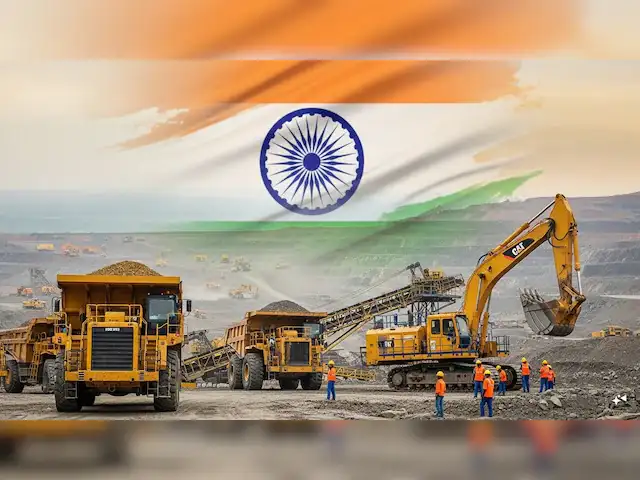
India was once called the ‘golden bird’. For this reason, the news of the opening of the first big private gold mine in Andhra Pradesh has raised many questions in the minds of people. Is India once again exploring for gold on a large scale? Will the need for gold imports reduce? Will this be of great benefit to the country’s economy? Although this news seems important at first glance, the real story behind it is even more interesting. This is not only the inauguration of a new mine, but also the beginning of a new chapter for private sector gold mining in India. However, this does not at all mean that India will suddenly become self-sufficient in gold. To understand the whole story, it is important to understand the specifics of this development.
The country’s first big private gold mine has come up in Jonagiri village in Kurnool district of Andhra Pradesh – now named ‘Swarangiri’. Developed at a cost of approximately ₹400 crore, the project will use open-pit mining technology to extract gold. Initial exploration has confirmed the presence of over 13 tonnes of gold, and it is estimated that this figure could increase to 42 tonnes following further exploration. However, this gold will not be extracted all at once. Production is expected to be around 400 kg in the first year, which will later increase to 900 kg to one tonne annually. In fact, while this project is a new beginning for India, it will not bring any immediate change in the overall situation.
**First big private gold mine started in Andhra Pradesh**
The country’s first big private gold mine has started in Jonagiri village in Kurnool district of Andhra Pradesh; The name of this village has also been changed to ‘Swarangiri’. Till now, gold mining was handled by government companies. This is the first big mine which has been handed over to a private company. This project has been started with an investment of approximately ₹400 crore. It will be an open-pit mine, meaning the gold will be extracted through open excavations rather than tunnels underground. The discovery has confirmed the presence of more than 13 tons of gold at this place. With further exploration, these reserves could reach 42 tonnes. However, not all the gold will be extracted at once; The plan is to extract about 400 kg of gold in the first year. Later the production may increase to 900 kg to 1 ton per year. This project is expected to last for about 15 years.
Gold is nothing new to India; This country has been famous for its gold wealth since the Vedic period and Ramayana-Mahabharata. It is reasonable to assume that even at that time gold mining took place in the country. However, large-scale gold mining using modern technology began during the British period. The British company John Taylor & Sons began modern mining operations in the Kolar Gold Fields (KGF) in Karnataka around 1880. It was one of the deepest mines in the world, reaching a depth of approximately 3.2 kilometres. During its 120 years of operation, 800 to 900 tons of gold was extracted from this mine. There was a time when KGF alone accounted for about 95 percent of India’s total gold production.
Why was KGF closed?
In 1956, the Kolar Gold Fields (KGF) was nationalized and its functioning was handed over to Bharat Gold Mines Limited (BGML). However, gold production there continued to decline over time. The situation became such that the cost of mining exceeded the price of the gold being extracted. Eventually, due to not being economically profitable, KGF had to be closed down in 2001. This is considered a major turning point in the history of mining in India. Even today, KGF is considered one of the most historic gold mines of India.
How much gold is produced in India today?
Even today, about 1 to 1.5 tonnes of gold is extracted every year from the Hutti gold mines in Raichur district of Karnataka. Mining also takes place in some other small places, although not on a large scale. 1 to 1.5 tonnes of gold may sound like a lot, but it is very less as per India’s needs. India imports about 700 to 800 tonnes of gold every year; Therefore, this level of domestic production is considered almost negligible compared to the demand of the country.
Which country produces the most gold?
China is the world’s largest gold producing country, producing about 370 to 380 tons of gold every year. This is followed by Russia (about 325 tonnes) and Australia (about 280-290 tonnes), while Canada produces about 200 tonnes of gold every year. America, Ghana, Peru and Mexico are also among the big producing countries. There was a time when South Africa was the leader in gold mining, with annual production reaching 1,000 tonnes; However, production there has since declined to about 100 tonnes. In comparison, India’s production lags far behind these big global countries.
Will a new mine change the situation for India?
Even if a new mine in Andhra Pradesh produced one tonne of gold every year, its impact would be tiny compared to India’s total demand. Last year, India imported gold worth about $72 billion (about Rs 6 lakh crore). Therefore, this single mine is not likely to have any significant impact on import volumes. However, experts consider it an important start. If this project is successful and private companies earn good profits, then exploration of new mines may accelerate in other areas of Odisha, Madhya Pradesh, Karnataka and Andhra Pradesh.
Pakistan is also moving ahead in search of gold
Like India, Pakistan is also betting big on its mineral resources. It has handed over the Reko Dik mine in Balochistan to a foreign company for gold and copper extraction. It is estimated that about 1,270 tonnes of gold is present at this place. According to initial plans, production is expected to begin in 2028, with the first phase producing 7 to 8 tonnes of gold per year; Later production may increase further. However, long-standing security challenges and insurgency in Balochistan remain major obstacles to the project.
A small beginning, but big expectations
Today, almost every country is engaged in exploration of new gold mines. In India too, the opening of the first major private gold mine is being considered an important step in this direction. Although this development will not immediately meet the country’s gold needs nor have any significant impact on imports, the situation may change. If future exploration is successful, use of modern technology increases and mining is done while maintaining environmental balance, India can gradually increase its domestic gold production. Therefore, this project in Andhra Pradesh is being seen not just as a new mine, but as a sign of future potential in India’s mining sector.