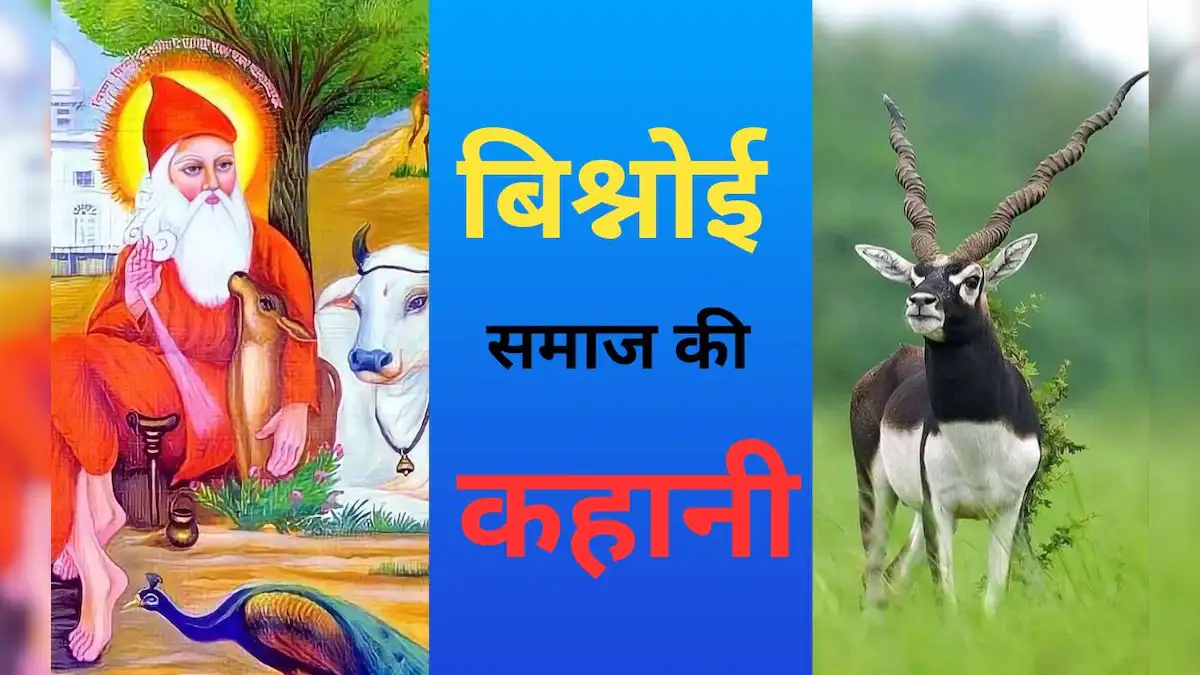
The movement in Rajasthan to save Khejri trees has once again brought the Bishnoi community into the limelight. The Bishnoi community of western Rajasthan is known for their unique beliefs, which include their deep love for animals and their unwavering devotion towards the forests and the land. The Bishnoi community has been following the traditions of ancient nature-worshipping societies. The famous blackbuck and chinkara hunting incident was also related to the Bishnoi community. Let us know why Bishnoi community is so unique and what are their special beliefs…
Bishnoi community is a religious and social community of India which is identified not only by worship or traditions, but by living in harmony with nature. This community considers itself the protector of trees, plants, animals, birds and the environment before considering itself as a human being. Today, when environmental protection is considered a modern thought, the Bishnoi community had made it the basic principle of their life centuries ago.
When was this community established?
The Bishnoi community was founded in the 15th century by Guru Jambheshwar, also known as Jambhoji. At that time, the Thar region of western Rajasthan was suffering from severe drought, famine and ecological imbalance. At such times, Guru Jambheshwar suggested a way of living that could protect human life without harming nature. He created 29 rules of life, which are called ‘Neem’ or ‘Niyam’. This community is called ‘Bishnoi’ because of these 29 rules—twenty (20) and nine (9), that is, 29.
The core of these 29 rules is environmental protection. According to Bishnoi belief, killing any living creature is a sin. Protecting wild animals, especially blackbuck and chinkara, is considered a religious duty. It is strictly prohibited to cut green trees, especially Khejri trees. Khejri tree is considered the lifeline of the desert as it provides greenery, shade, fodder and food even during drought. For the Bishnoi community, the Khejri tree is not just a tree but a living deity.
Special importance of purity and restraint
Purity and restraint have special importance in Bishnoi beliefs. Strict vegetarianism is followed in the community. Not only are meat, fish, and eggs forbidden, but the consumption of any intoxicating substance—alcohol, tobacco, opium—is strictly prohibited. The tradition of filtering water and milk before drinking is also linked to this belief, so as to avoid killing microorganisms. This rule shows that Bishnoi philosophy advocates the protection of all forms of life, not just large organisms.
The Bishnoi community also has very strict and clear beliefs regarding personal and social behavior. Bathing daily, wearing clean clothes, leading a simple life, earning one’s livelihood honestly, and abstaining from theft and lying—all these rules are meant to maintain discipline and purity in life. Emphasis is laid on both external cleanliness and internal purity, so that one’s behavior and thoughts remain balanced.
Bishnoi community worships Lord Vishnu
Religiously, the Bishnoi community worships Lord Vishnu. Guru Jambheshwar is considered to be an incarnation of Vishnu. The community has a tradition of performing Havan daily and fasting on Amavasya (new moon day). The purpose of these religious rituals is not just to worship, but to inculcate self-control, gratitude towards nature and a sense of responsibility towards life.
When 363 people gave their lives to save Khejri trees in 1730
The Bishnoi community is counted among the world’s first environmental warriors. The biggest example of this is the Khejarli incident of 1730, when the soldiers of the ruler of Jodhpur came to cut Khejar trees. At that time, Amrita Devi Bishnoi and 363 others gave up their lives by clinging to trees. His motto—”Even if one has to sacrifice one’s head to save the tree, it is a bargain”—remains the guiding principle of the Bishnoi community even today. This incident is considered to be the greatest example of sacrifice in Indian environmental history. Compassion towards nature is an integral part of Bishnoi life. Caring for injured or orphaned animals, raising and feeding deer calves—all this is common in this community. Animals and birds are considered members of society and not just resources.
core beliefs remain intact
Today, the Bishnoi community lives mainly in Rajasthan, Haryana and Punjab. Despite the pressures of modernity and development, the community has largely preserved its core beliefs. Whenever any plan is made that harms the environment, the Bishnoi community is the first to protest. In short, the Bishnoi community is not just a religious group, but a living environmental philosophy. Their beliefs teach that the future of human civilization can be secured only by living in harmony with nature, not by fighting it.