Why was no other organization like Rashtriya Swayamsevak Sangh (RSS) formed? Many organizations have tried to expand as strongly as this organization, but why have they not been able to achieve that level of strength? The answer to this question lies in three words: “Full-time missionary arrangement.” It means leaving home, society and family, being ready to do whatever the organization asks and going wherever it sends, and living a simple life. This system was established to instill a sense of patriotism among the youth and to focus on the goal. Today, learn the story of four men who were the first pracharaks of the RSS.
These four preachers were Baba Saheb Apte, Dada Rao Parmarth, Rambhau Jamgade and Gopal Rao Yerkuntwar. After two years of training, in 1929, Dr. Keshav Baliram Hedgewar began to formalize the missionary system. In 1930, when Dr. Hedgewar came to participate in the civil disobedience movement, Jungle Satyagraha, he resigned from the post of Sarsanghchalak. Dr. Paranjape was appointed the new Sarsanghchalak. After this, Dr. Hedgewar entrusted Baba Saheb Apte with the responsibility of looking after all the branches operating in Nagpur and surrounding areas. Hedgewar knew that he might have to go to jail. He had full confidence in Baba Saheb Apte’s abilities and Baba Saheb kept his trust intact.
Baba Saheb Apte is considered the first preacher
In 1931, after Baba Saheb was released from jail, Dr. Hedgewar chose Baba Saheb Apte as his full-time preacher. By then, Apte was doing various odd jobs along with working for the union. He had no objection to working everywhere, from printing press to insurance company. During this time, Dr. Hedgewar selected three other volunteers, slightly younger than him, to become full-time preachers. These four are known as the first campaign group of the Sangh. All three had received OTC education. Baba Saheb Apte is considered to be the first among them.
Umakant Keshav Apte was born in a poor family of Yavatmal. He was very conscious about studies from the beginning. He had special interest in the heroic stories of history. Whatever book he got his hands on, he never left it without reading it completely. He was a great admirer of Tilak. Once in school it was learned that Tilak would be passing through Yavatmal by train that day. The principal closed the main gate to stop the children and even beat them. But as soon as school was over, Apte ran away with his friends. By then Tilak had left. He told his principal, “I have seen Tilak in my mind.” Even after becoming a teacher, his devotion towards Tilak continued.
Every story in this special series on RSS centenary
In that school located in Dhamangaon, Wardha, he used to continuously narrate the heroic stories of the heroes of Indian society to the children. The administrators didn’t like it. One day, on the occasion of Lokmanya Tilak’s birth anniversary, he organized a program in his memory in the school. The managers did not like this and after their objection, Umakant left his job in anger. In 1924, he came to Nagpur, came in contact with the Sangh and, like him, met Dr. Hedgewar, an old supporter of Tilak, and became a volunteer of the Sangh. Seeing his passion for reading, Dr. Hedgewar called him “Akshar Shatru”.
Baba Saheb Apte is called the first preacher of the Sangh.
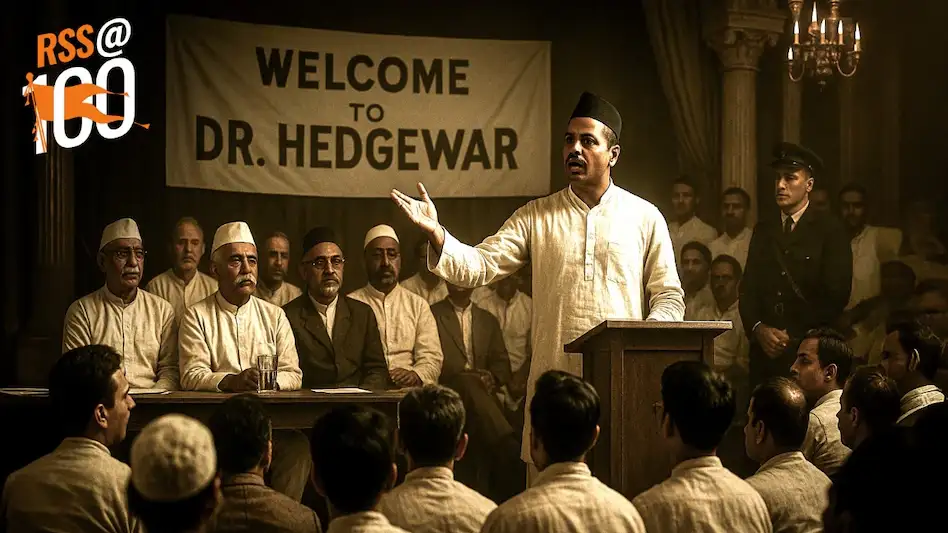
A small program was organized in Nagpur for the initiation of the first full-time pracharaks of the Sangh, where some prominent volunteers were present. In the same program, Dr. Hedgewar gave a short speech, in which he emphasized the resolve of the organization and the saintly life of the preachers. After this, their centers were determined and it was told which city or province they would go to preach. Apte was sent to Khandesh, where he was given the responsibility of Dhule and Nandurbar. Dada Parmarth was given the responsibility of Pune, Yerkuntwar of Sangli and Jamgade of Yavatmal.
The first preacher to sow the seeds of Sangh in the North-East
Dadarao Parmarth, also known as Govind Sitaram Parmarth, was a resident of Nagpur. He had expressed his anger towards the British in the answer sheet of class 10th examination. His teachers had failed him, so he dropped out and volunteered with Dr. Hedgewar. He supported Dr. Hedgewar in the Jungle Satyagraha of 1930 and also went to jail. When he fell ill, Dr. Hedgewar took care of him in jail. He has another major achievement to his credit: He was the first pracharak to expand the work of the Sangh in the North-East. In 1946 he was sent to Assam. When the Sangh was banned in 1948, Dadarao remained absorbed in meditation in the Aurobindo Ashrams in Pondicherry and Rishikesh. Having become absorbed in spirituality, he had no desire to return. With great difficulty Appaji Joshi persuaded him to return. Yavatmal, the eastern Maharashtra region he inherited, remained his center and he spent a long time achieving this goal, and expanding the Sangh’s network throughout the region.
Gopal Rao Yerkuntwar, the preacher who connected the great preachers of the future
Gopal Rao Yerkuntwar produced many dedicated preachers in his time, who perhaps cannot be compared with anyone else. One of them was Bhaskar Rao Kalambi, who is considered to be the head of Vanvasi Kalyan Ashram. Gopal Rao also brought him into the Sangh. Gopal Rao also brought Moreshwar Raghav and Morubhai Munje, who initially raised the flag of the Union in Punjab. When Dr. Hedgewar sent these four from Nagpur for missionary work, Moreshwar was very impressed and considered Gopal Rao as his role model.
All these pracharaks are recorded in the history of the Sangh for various achievements. Keshav Apte even wrote “Bharatbhakti Stotra” consisting of 33 verses. His work of rewriting Indian history continued for decades. It was from here that the seeds of another new organization within the Sangh, the History Compilation Committee, were sown. Apte once made “Dasbodh” handwritten and typed Veer Savarkar’s book “1857 Freedom Struggle” available to many youth. Seeing his studiousness, Dr. Hedgewar gave him the new name “Baba Saheb”. Later, he also became close to Guru Golwalkar, and his advice played an important role in shaping the Sangh’s stance during partition.