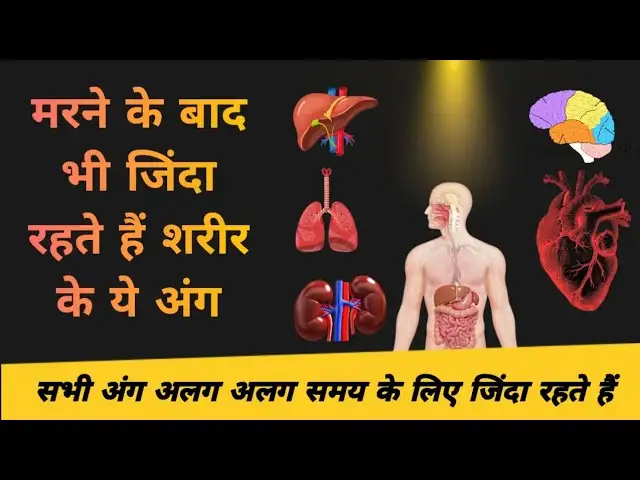
It is often believed that when the heart stops beating, all the body parts stop working together, but medical science says something else. According to doctors, after death, different parts of the body remain active for different periods of time. It depends on how much oxygen the organ needs and how quickly it degrades.
Every organ has its own life span
The life span of all parts of the human body is different. After death, the heart can usually function for 4 to 6 hours, while the lungs can function for 4 to 8 hours. The liver continues to work for about 8 to 12 hours. The eyes are considered suitable for transplant for about 4 to 6 hours. The skin can be protected for up to 24 hours, while some organs remain intact for even longer.
Which organ survives the longest?
According to doctors, kidney is the organ that continues to function for the longest time after death. Kidneys can function for approximately 24 to 36 hours. This is the reason why it is considered the strongest part of the body. Kidneys can be transplanted successfully once they are preserved in the right temperature and conditions.
Why are kidney transplants more successful?
The ability to preserve the kidney for a long time is the biggest reason for the success of kidney transplant. Apart from this, the role of kidney is very important in the body, because it cleans the blood and removes toxic substances from the body. This is why kidney transplant is one of the most commonly performed organ transplants in the world.
How are organs useful even after death?
When a person dies, some of his organs are not completely inactive. These organs are removed at the right time and kept safe under special conditions. This entire process is called organ transplantation. Through this, a deceased person can give new life to many needy patients.
On what factors does the functioning of organs depend?
How long organs continue to function after death depends on many factors, such as the cause of death, body temperature, how quickly the organs were preserved, and the type of medical care received. Therefore, the timings mentioned above should be considered approximate and not exact timings.