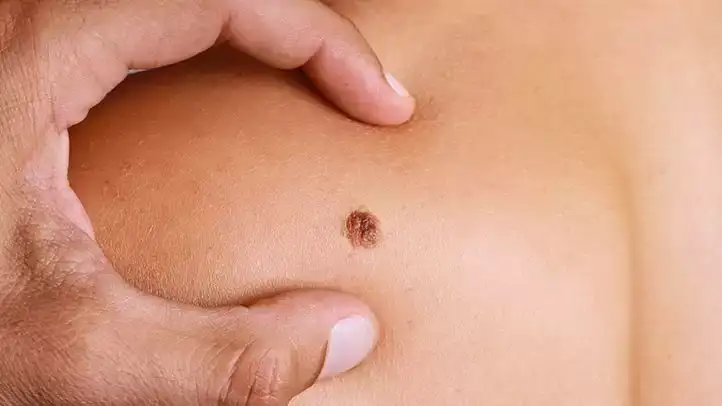
Skin cancer is one of the fastest growing diseases worldwide. Skin cancer cases are increasing rapidly in India also. According to experts, this is one of those cancers whose early symptoms are clearly visible on the skin. Therefore, if it is detected in time, skin cancer treatment can be easy and successful to a great extent. However, the problem of skin cancer increases when people ignore the initial changes in the skin and mistake them for normal skin problems. So let us tell you today what are the symptoms of skin cancer, which you should not ignore.
What are the early symptoms of skin cancer?
Most people are aware of moles, freckles and blemishes on their body. Early symptoms of skin cancer often appear in the form of changes. If a new spot appears on your skin or the color or texture of an old mole suddenly changes, it is considered an early sign of skin cancer.
Skin cancer can also be identified using the ABCDE rule
A – Asymmetry – Experts recommend following the ABCDE rule for skin cancer detection. A represents a part of the mole that does not match the other parts.
B – Border – B refers to the area of the mole that appears irregular, blurred, or cracked.
C – Color – C indicates more than one color, such as brown, black or white, which may also indicate skin cancer.
D – Diameter – D refers to an increase in the size of the mole, especially if it exceeds 6 mm.
E – Evolving – E represents the change in mole over time. This includes itching, pain, bleeding, or the formation of a new mole.
Other early symptoms of skin cancer
A new bump or sore on your skin that does not heal for weeks may also be a sign of skin cancer.
Persistent itching, pain, or burning in the mole or patch is also an early sign of skin cancer.
Frequent crusting or bleeding from the wound is also a common symptom.
Continuous increase in the size of a spot on the skin or its spread to the surrounding skin is also a sign of skin cancer.
Waxy or shiny bumps on the skin are also common symptoms of skin cancer.
Red, rough, or scaly spots on the skin are also symptoms of skin cancer.
Who is most at risk for skin cancer?
According to experts, people with fair skin, those who spend long periods of time in the sun, or those who have a family history of the disease are at greater risk. The elderly, those with weakened immune systems, and people with multiple moles are also at greater risk. Experts recommend that you ignore any abnormal changes in your skin, non-healing wounds or any sudden changes in moles and consult a doctor immediately.