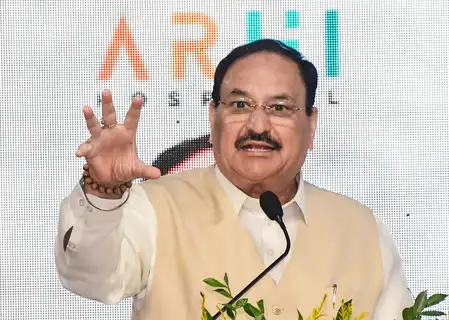
New Delhi, June 7 (IANS). Union Health Minister Jagat Prakash Nadda launched a scathing attack on Congress President Mallikarjun Kharge, terming his health-related comments based on incomplete information. On social media platform ‘X’, Nadda said that incomplete information can create confusion on an important subject like public health. Citing NFHS-6 data, he defended the work done by the central government in the health sector.
Nadda wrote in a post on ‘X’, “Kharge ji’s incomplete information is dangerous. The issue of public health is so important that it cannot be limited to political rhetoric only. Politics can be achieved through selective information, but the country is benefited only by facts.”
The Union Minister mentioned the improvements in the health sector while comparing the data of NFHS-3 (2005-06) and NFHS-6. According to him, the percentage of women registering in the first trimester of pregnancy has increased from 43.9 percent to 76.2 percent. Institutional deliveries have increased from 38.7 percent to 90.6 percent, while the percentage of deliveries taking place under the supervision of skilled health workers has increased from 46.6 percent to 91.3 percent.
He said that the full vaccination coverage has been recorded at 87.1 percent. Health insurance coverage has increased from 4.9 percent to 60.2 percent. At the same time, the rate of stunting, one of the main indicators of malnutrition in children, has decreased from 48 percent to 29.3 percent.
Nadda said that these are not just figures, but the story of better health of millions of mothers and children. He also criticized the tenure of the UPA government and described it as a period of policy failure.
The controversy started with a post by Congress President Mallikarjun Kharge. Kharge had alleged that the central government was not making some data of NFHS-6 public. He said, “The Modi government is not only betraying women and children in matters of health and nutrition, but is also suppressing important data.”
Kharge claimed that one in five children suffers from severe malnutrition, one-third are underweight and 84 per cent of children in the age group of 6 to 23 months do not receive adequate nutrition. He also said that 57 percent of women are suffering from anemia. Also, he accused the government of hiding failures by presenting selective figures.
–IANS
SCH/AS