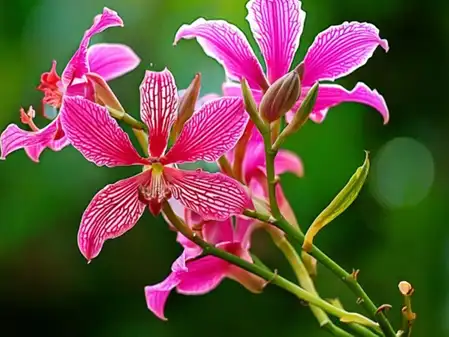
New Delhi, October 31 (IANS). Some flowers are so beautiful to look at that it seems that they can be used only for decoration, but it is not so. Kachnar flower not only looks attractive but is also full of medicinal properties.
Not only the flowers, the bark, leaves and roots of Kachnar are also used to get relief from many diseases. Kachnar flower is also known by different names. It is also called Kanchnar or Karali. Its scientific name is Bauhinia Variegata and it is also known as Bauhinia Variegata or Orchid Tree in English.
The special thing is that Kachnar plant can be planted anywhere. It is found in almost every part of India. Kachnar flower is beneficial in many diseases. Its flowers have anti-inflammatory and antioxidant properties, which help in reducing lump problems, boils, skin problems, liver problems and swelling in the body. Kachnar flower is called “Raktapitta Hara” in Ayurveda, which simply means, the destroyer of blood related diseases.
In women who suffer from bleeding problems, the amount of blood during menstruation is more or less. In such a situation, taking Kachnar powder is beneficial. It provides relief from menstrual problems in women and works to purify blood. Not only this, Kachnar is said to be the enemy of lumps in the body. If women suffer from uterine fibroids, then consumption of Kachnar flowers or bark powder will prove beneficial.
Kachnar flowers and leaves have antioxidant properties, which strengthen the body and increase the body’s immunity. Due to this, infections caused by change in weather do not bother you. For consumption, flowers and leaves can be boiled and drunk or a vegetable can be made from the leaves.
Kachnar flowers are also beneficial in respiratory problems and skin related diseases. If there is a problem of ringworm or itching and dark spots on the skin, then the flower can be ground and the paste can be applied on the affected area. Kachnar flower has a cooling effect, which provides relief from burning sensation. Before consuming Kachnar flowers, roots and bark, consult an Ayurvedic doctor.
–IANS
PS/VC