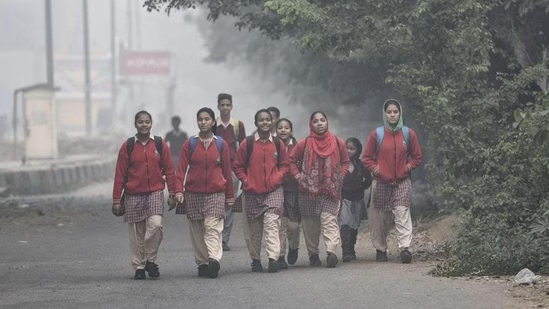
With the onset of winter in the national capital Delhi and NCR, the color of the air has again become poisonous. According to the Central Pollution Control Board (CPCB), Delhi’s overall air quality index (AQI) reached 425 at 9 am on Tuesday, which falls in the ‘severe’ category. This figure increased sharply from 362 on Monday, which is believed to be due to calm winds, stable weather and accumulation of pollutants near the surface. Due to this, the Commission for Air Quality Management (CAQM) has implemented Stage-III of the Graded Response Action Plan (GRAP) with immediate effect.
Strict restrictions under GRAP Stage-III
According to the CAQM statement, Stage III is activated if the AQI remains above 400 for 48 hours, which is designed to curb emissions and prevent further deterioration of air quality. The major restrictions are as follows:
Prohibition on construction and demolition: Non-essential construction, demolition activities suspended across NCR. Mining and stone crushers closed: Mining operations and stone crushing plants suspended in all districts of NCR. Ban on old vehicles: Operation of BS-III petrol and BS-IV diesel four-wheelers banned in Delhi and Gurugram, Faridabad, Ghaziabad, Gautam Buddha Nagar. Exemption to disabled persons and essential services vehicles. Hybrid mode in offices: Promote work-from-home or hybrid model in government and private offices, so that the number of vehicles is reduced. Other measures: Road fogging, mechanical sweeping and increased garbage collection at pollution hotspots. Use of diesel generator sets also limited.
These restrictions are in addition to the existing Stage-I and II measures, which have been in place since October 19. CAQM has warned that if AQI goes above 450, Stage-IV may be activated.
Hybrid classes in schools: Online option till class 5
In view of the increasing levels of pollution, the Delhi government through the Directorate of Education (DoE) has issued instructions to all government, aided and private schools. Classes up to Class 5 will be conducted in hybrid mode (both online and offline) with immediate effect, until further orders. Parents can choose online or physical presence for their children to minimize maximum exposure to toxic air. Physical classes will continue in middle and senior classes.
“All school heads are directed to adopt hybrid mode till Class 5, wherever possible,” the DoE notice said. This decision was taken giving priority to the health of children, because small children are more affected by pollution.
Chief Minister Rekha Gupta’s statement: “Children’s health is priority”
Chief Minister Rekha Gupta said in a press briefing, “We have taken this decision after discussions with several departments so that the health of the children is safe. The situation is being monitored. Measures like dust control, garbage cleaning and traffic management are being implemented with full sincerity.” He stressed that the Delhi government is committed to fighting pollution throughout the year, and 70 lakh saplings are being planted under the ‘Shuddh Hawa Sabka Adhikar’ scheme. Gupta also appealed for cooperation from neighboring states, as Delhi’s pollution is affected by NCR.
Health Concerns and Precautions
Doctors have warned that prolonged exposure to smog can cause problems like cough, shortness of breath and throat irritation, especially in children and the elderly. The Health Department has instructed hospitals to be prepared for the increase in pollution-related diseases. Citizens have been advised to:
Reduce outdoor activities. Wear a mask and run a home air filter. Keep windows closed and maintain humidity.
According to the Meteorological Department, pollution may increase further due to low wind speed in the next few days. Experts say this problem persists annually due to stubble burning, vehicle emissions and local sources. The Delhi government has emphasized on long-term measures like mist sprayers and smart traffic systems.