The Delhi government carried out cloud seeding in several parts of the city on Tuesday afternoon. Environment minister in Chief Minister Rekha Gupta’s cabinet said it was part of efforts to find solutions to artificial rainfall aimed at reducing pollution levels.
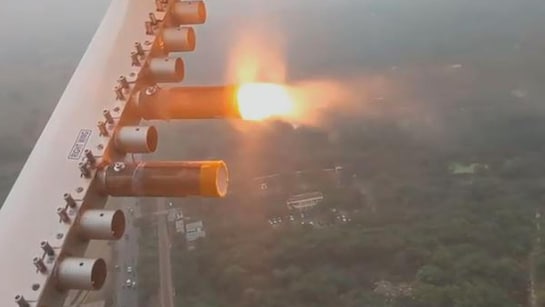
It is noteworthy that this operation was carried out by IIT-Kanpur using Cessna aircraft equipped with salt-based and silver iodide flares to cause precipitation.
The aircraft entered Delhi from Meerut side and the experiment was slightly delayed from the scheduled time of 12:30 pm due to poor visibility. The first cloud-seeding test flight was conducted on 23 October, paving the way for artificial precipitation operations to take place on 28–30 October.
Sirsa said the areas covered are Khekra, Burari, North Karol Bagh and Mayur Vihar. He further explained that eight flares were used during the process, each weighing between 2 and 2.5 kg.
Sirsa said in a video statement, “The second trial of cloud seeding has been conducted in Delhi. It was conducted by IIT Kanpur through Cessna aircraft. The aircraft entered Delhi from the direction of Meerut. Under this, Khekra, Burari, North Karol Bagh, Mayur Vihar were covered. 8 flares were used in cloud seeding. The weight of each flare is 2-2.5 kg. Flares released material in clouds. The clouds had 15-20% humidity. This process continued for half an hour and during this time a flare continued for 2-2.5 minutes. The plane has now landed in Meerut.”
Sirsa said the third trial of cloud seeding will be conducted later today after two successful rounds conducted by IIT Kanpur to explore the possibility of artificial rainfall. After completion of the second test of cloud seeding, Cessna aircraft has landed in Meerut.
Sirsa said, “The second flight and the third test will be conducted today itself. According to the IMD, the winds are blowing northwards and clouds may cover anywhere in outer Delhi. IIT Kanpur believes that it may rain for 15 minutes to 4 hours. We are hopeful that the results of IIT Kanpur will be positive. If it is successful, then long term planning till February can be done in the coming days. Such flights will continue in the coming days. Every day if the weather is favourable. nine Ten tests will be conducted.”
Cloud seeding involves artificially producing precipitation by inserting specific particles, such as silver iodide crystals or salt-based compounds, into moisture-rich clouds.
Planes are used to disperse these particles, turning small cloud droplets into larger rain drops, which can potentially cause precipitation.
Post Diwali, the air quality index (AQI) in Delhi and the National Capital Region (NCR) has reached ‘poor’ and ‘very poor’ categories in many areas, while Phase 2 of the Graded Response Action Plan (GRAP) is still in effect.
According to the Central Pollution Control Board (CPCB), the AQI in Delhi as of 1 pm on Tuesday was 304, which is classified in the ‘very poor’ category.
Among the monitoring stations in the city, the AQI was recorded at 311 in Anand Vihar, 316 in RK Puram, 347 in Siri Fort, 334 in Bawana, 319 in Burari Crossing, 311 in Dwarka Sector 8, 318 in Mundka, 302 in Narela and 313 in Punjabi Bagh – all placed in the ‘very poor’ category.