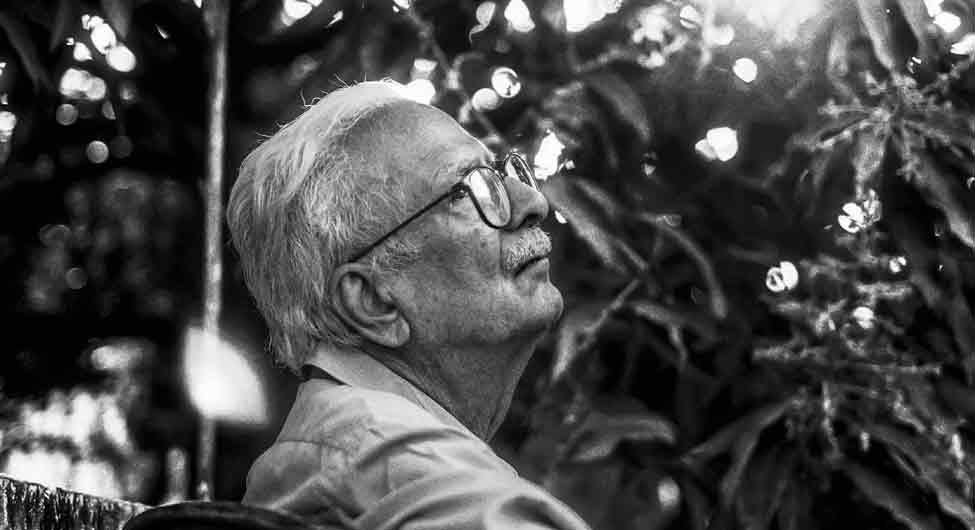
Vinod Kumar was a poet who created illusions of spiritual experiences or philosophical conclusions in Shukla language.
Vinod Kumar Shukla is no more, this sentence has been resonating for the last few days with such intensity that his presence is being felt everywhere in Hindi literature. It can be said that the contrast which Vinod Kumar Shukla’s poetry used many times has drawn such a thread of memory between life and death that death is tied to life and we are able to feel our poet speaking among us, rather if we take the help of his own style, we are busy postponing the momentaryness of his ‘no longer being’ and reading and remembering him as if he was timeless.
A lot has been written on Vinod Kumar Shukla in the last few days. Despite not being able to add anything new to them, the purpose of writing this comment is to try to feel the experience that made Vinod Kumar Shukla, because from the very beginning it is visible that Vinod Kumar Shukla ultimately belonged to the world of poetry. Ashok Vajpayee might have been saying this – although later he felt the need to go beyond this – that poetry has its own democracy and literature has its own autonomous citizenship, but the one who made this democracy possible in the real sense, who kept earning this citizenship through his poetry, was undoubtedly Vinod Kumar Shukla.
Perhaps it was because of this very subtle citizenship that he understood that what is invisible must be seen and must also go beyond what is visible. They looked at the rock of time and it could move and fall at any time – it was just that its moving and falling was postponed. This skill of seeing the moment in the mirror of the beyond made him unique.
However, this should not create the illusion that Vinod Kumar was a poet who created illusions of spiritual experiences or philosophical conclusions in Shukla language. He was a very consciously social, very deeply political and very sublimely human poet. His poetry collections like ‘Almost Jaihind’, ‘That man has gone away wearing a new warm coat like a thought’, ‘Everything will remain to be’, ‘Atariyat Nahi’, ‘Poetry is bigger than poetry’, on the one hand, are evidence of his rugged experimentalism and on the other hand, of the poignant sensitivity with which he is molding words into new meanings and new forms in the factories of his poetry, filling them with maximum softness and possibly also warmth. Within the scope of his efforts there is also a sense of privacy, a touch of family, concern for neighbours, and concern for the country and the world. Although this poem is not expressed in any familiar political idiom, it takes shape amidst the natural and cultural situation of his small region – with the mention of very minor people and events, amidst very faint but not unheard calls, creating the spirit by which this culture has preserved its innate vitality despite many pressures. In his small poems, his modesty, his connection with his home, his courtyard, his earth and the sky, is expressed with a different aura – ‘Before migrating, I think about where to live / I look at the sky / I salute the courtyard / I look at the earth / And I salute the corner of the house / In front of the house, the backyard / The sheds, the niches, the walls / This side of the house, the other side / The open window, the door. Day and night / I salute the people / that residents! I salute you.’ Is this loving humility also not a means of seeing the world in great depth, which Vinod Kumar Shukla makes possible in poetry?
Interestingly, whenever Vinod Kumar Shukla is remembered, he is primarily remembered as a poet, whereas we are finding that his fame as a novelist is gradually expanding. When ‘Naukar Ki Kameez’ was published in 1979, that novel was welcomed differently in Hindi. Generally, the wonder world of stories is created by what will happen next, but Vinod Kumar Shukla’s wonder world is created by what has already happened. The house unfolds as a central metaphor in this novel. Santu Babu leaves the house as there is a house to leave and then a house to return to. Having a home is actually the satisfaction of being yourself. Hindi has a whole tradition of poor and struggling heroes and novels centered on them, but those characters are as individualistic as they are or even more caste-specific – they seem to be representatives of some class or the other – be it farmers, labourers, artisans or clerks. With ‘Servant’s Shirt’ Vinod Kumar Shukla returns his individuality to the hero, without saying anything he removes his class character and brings his human face to the fore. This face shaves, brings vegetables, talks to his mother, calls his friend, spends the time and expense of watching a movie amidst the struggle for money – and the apparent banality with which he does all this is heart-wrenching. He is exploited but so gradually that he no longer has the desire to protest. Santu Babu says, “The scope of the conflict was very small. The attacks were from far apart and slowly. The injury did not seem very severe. Exploitation had such a minor impact that no one felt like rebelling, or the rebellion itself was very minor. My salary was a barricade which was not in my power to break. He fit me like a tight shirt and I was getting paid from full strength to the point of weakness. Through this hole in the dock, I used to watch movies or dream.
Vinod Kumar Shukla’s next novel came with the name ‘Khilega To Dekhen’, but it did not get the same appreciation or acceptance in Hindi that ‘Naukar Ki Kameez’ had received. But when ‘Deewar Mein Ek Khirki Rahti Thi’ was published in the year 2000, the Hindi world was shocked afresh. What kind of novelist is this who has brought poetry into his novels? A popular – though less accepted – criticism of Vinod Kumar Shukla is that he creates a kind of formalism in his writings – a soft reality in which everything seems good, the harshness of it disappears and so does the will to fight for it. He was also criticized for the fact that he does not comment on the immediate political-social situation, remains unaware or indifferent to it and he is also not averse to those leaders who have been playing the open and scary game of communalism or oppression of Dalits and tribals in Chhattisgarh or the rest of the country.
There is no harm in accepting that yes, such immediate reactions are not found in Vinod Kumar Shukla. But the reason for this does not lie in any ideological or strategic migration of theirs, but in their nature which is used to seeing the reality developing very slowly, very faint voices, very invisible scenes – they express their resistance not by shouting, but by remaining silent – perhaps not consciously, but by creating their own separate literary citizenship outside the perimeter of state power.
In fact, it is this citizenship which makes Vinod Kumar Shukla, sitting in remote Raipur, almost a world-renowned person. We find that he is getting big awards from the country and the world – like Jnanpith and Penn Nabakov – royalty of Rs. thirty lakhs is coming, which hardly any Hindi writer before him has received in lump sum. It is true that all this came very late in his life, but considering the delayed rhythm in which he was used to living, there was a kind of aversion to fame, it was appropriate that it came whenever it came. This also gave assurance that there is a window in the continuously hardening wall of Hindi, through which there is a possibility of fresh breeze coming in and out.
(The author is a senior journalist and critic)
Two poems published in Outlook’s Today’s Challenges issue, 3 December 2018
This is true
that my father is from Uttar Pradesh
Came here
I was born here
my father’s birth
my daughter’s too
who is now fifty years old
or fifty one years old
She got married in Maharashtra
Neither could I go there for ten or five years.
Nor would she have been able to come here for ten or five years
So much so that she also settled there.
in this settlement
But I am so tired of my own people
that I went to my old neighbor’s house
so for him
Came from Uttar Pradesh.
I am an old outsider in the street.
rather steadfast exterior
to be desi
There is no country in the country.
…….
I found myself in my house
Has been detained –
no one can hide anymore
Still I know this.
The law didn’t look at me
But the sight had reached the neighbor
The neighbor never did anything like this,
he was so open
that in his personality
there was no closed window
His words could be heard through the open window
even his thoughts
Visible through the open window.
in his one room house
there wasn’t even a door
something was cooking at his house
maybe a conspiracy, no
food was cooking
And he was caught red handed!!