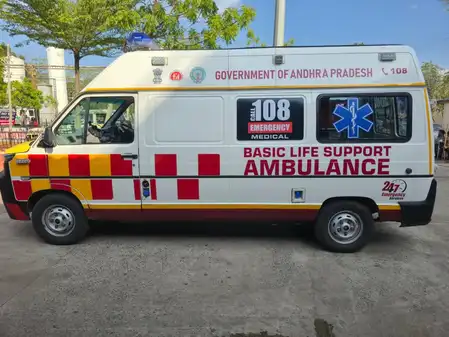
Vijayawada, June 7 (IANS). The Andhra Pradesh government has transformed the 108 ambulance emergency services into a highly efficient lifeline for millions of people.
Working on the core principle of ‘every second counts in saving lives’, the state’s emergency network has been modernized at par with international trauma care standards, according to an official release issued on Sunday.
The government, in partnership with Bhavya Health Care, has integrated advanced GPS tracking, real-time traffic routing, and digital patients logs into the ambulance. This ensures that victims can be reached and stabilized within the critical medical window of time known as the ‘golden hour’.
From June 2025 to May 2026, this revitalized framework successfully responded to 7,78,799 emergency calls, bringing hope to families across rural and urban Andhra Pradesh.
During this one year operational cycle, 108 emergency response teams stabilized 1,13,764 road accident victims at the accident site. Additionally, the service further strengthened its role as an important pillar of rural healthcare by safely transporting 1,05,786 pregnant women to advanced maternity care facilities, thereby significantly contributing to the reduction of maternal and child mortality.
The operational efficiency of the fleet of vehicles is divided into two important streams of medical logistics: inter-facility transfers (IFT) and non-IFT emergencies.
Under IFT, 2,53,022 cases were handled, with critical patients being transferred smoothly from primary health centers to tertiary super-speciality hospitals without disrupting the continuity of care.
Non-IFT emergencies included 5,25,777 cases. These included direct and rapid assistance sent to accident sites, homes and remote farms, where first aid on the spot and immediate evacuation to the nearest medical center were arranged.
Statewide emergency services provided assistance to a staggering 7,78,799 cases, including critical and strategic medical interventions in a variety of medical crises.
Road accidents were the highest, with 1,13,764 cases requiring rapid trauma stabilization, followed by 1,05,786 pregnancy and obstetric emergencies requiring safe labor monitoring and antenatal transport.
First responders managed 97,118 cases of respiratory distress, including immediate oxygen administration and advanced airway management.
According to the official statement, rescue teams successfully stabilized 49,342 non-vehicular injuries using bleeding control, and also handled 45,951 cardiac emergencies and 40,553 unconsciousness cases through advanced tracking and resuscitation protocols.
–IANS
ms/