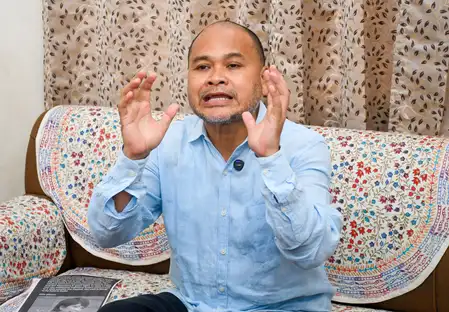
Guwahati, July 16 (IANS). Raijor party chief and Sivasagar MLA Akhil Gogoi on Thursday launched a scathing attack on the central government’s proposed ‘One Nation, One Election’ (ONOE) initiative. He alleged that this step has been taken with the aim of weakening the federal structure of India and centralization of power.
Addressing reporters, Gogoi claimed that the proposal would bring fundamental changes in the constitutional framework by reducing the autonomy of states and weakening the federal system of the country.
He alleged that the plan was an attempt to convert India into a unitary system of governance, contrary to the spirit of the Constitution.
Gogoi said that ‘One Nation, One Election’ is an effort to transform India from a federal democracy into a completely unitary state. India is a union of states, and no government has the right to dilute this constitutional principle.
The Raijor Dal chief urged the Center to withdraw the proposal, saying holding simultaneous elections was contrary to the democratic and constitutional structure of the country.
He further alleged that the initiative reflected a dictatorial mentality and warned that it would face widespread public opposition if it was taken forward.
Gogoi claimed that restructuring the electoral system in this manner would undermine democratic institutions and the federal balance envisaged by the Constitution.
He warned that if this proposal was imposed on the public, there would be a massive democratic movement throughout the country, in which citizens would unite to protect the Constitution and the federal form of India.
The MLA also said that if the proposal compromises the rights and powers of states, opposition parties and civil society groups will oppose any efforts to implement it.
The central government’s proposal to hold simultaneous elections for the Lok Sabha and state assemblies has sparked heated political debate across the country.
The government argues that holding simultaneous elections will reduce election-related expenses, improve governance and reduce disruption caused by repeated elections. At the same time, many opposition parties have opposed this proposal, saying that it raises concerns at the constitutional, systemic and federal levels.
The issue remains one of the major political disputes between the Center and the opposition.
–IANS
ms/