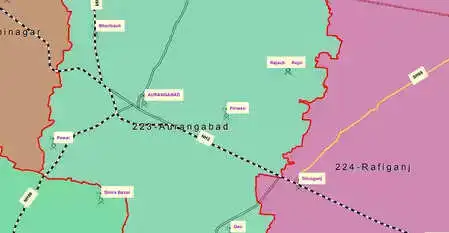
Patna, October 30 (IANS). Aurangabad in Southern Bihar is not just a district headquarters, but an area which encompasses centuries of historical heritage and modern political conflict. The margin of just 2,243 votes in the 2020 assembly elections proved that this seat is no longer the ‘stronghold’ of any one party.
Aurangabad assembly seat has long been considered a strong base of Rajput voters. This community, which accounts for more than 22 percent of the total voters, has often supported Rajput candidates.
Following the seat’s establishment in 1951, the initial elections were dominated by the Congress, winning eight times, while the Bharatiya Janata Party (BJP) made a strong presence felt, winning four times.
The victory of Rashtriya Janata Dal (RJD) in 2000 broke this political equation. This was the first time that a non-Rajput candidate won. Recently, in the 2024 Lok Sabha elections, RJD’s Abhay Kushwaha became the first non-Rajput and the first RJD MP to win from this seat, indicating that now not just caste, but party alliance and the image of the candidate are playing a decisive role.
The 2020 assembly elections made Aurangabad a high-profile and closely contested seat. Indian National Congress candidate Anand Shankar Singh defeated BJP’s four-time MLA Ramadhar Singh by a narrow margin.
Anand Shankar Singh had won in 2015 too, but the very small victory margin in 2020 indicates that despite Congress’s strong hold, BJP remains a strong contender.
The major issues influencing Aurangabad politics are related to rural development, including roads, electricity, water and irrigation. Additionally, poor conditions of rural health and education, unemployment and migration, and law and order also top the local agenda.
Aurangabad has also suffered the brunt of Naxalite activities for decades. However, Maoist incidents have declined in Bihar in the last five years. The state government has set a target to completely eliminate this insurgency by the end of 2025.
Aurangabad Assembly comes under Aurangabad Lok Sabha constituency, which has a total of six assembly seats. The demography of this assembly constituency is also quite diverse. There are 21.64 percent Scheduled Castes and about 19 percent Muslim voters here. Of the 3,17,947 registered voters, 53.49 percent had voted in the 2020 election.
Today, the region is characterized by its agricultural economy. The Adri River flows through here, while the Son River touches its western border. Despite the challenge of frequent droughts, farmers grow main crops like rice, wheat, pulses and mustard here. Traditional arts, such as carpet weaving and brass crafts are quite famous. Navinagar Super Thermal Power Plant has given a new impetus to industrial development, which has opened new doors of employment. The unexpected success of strawberry cultivation has also given farmers a new source of income.
–IANS
VKU/ABM