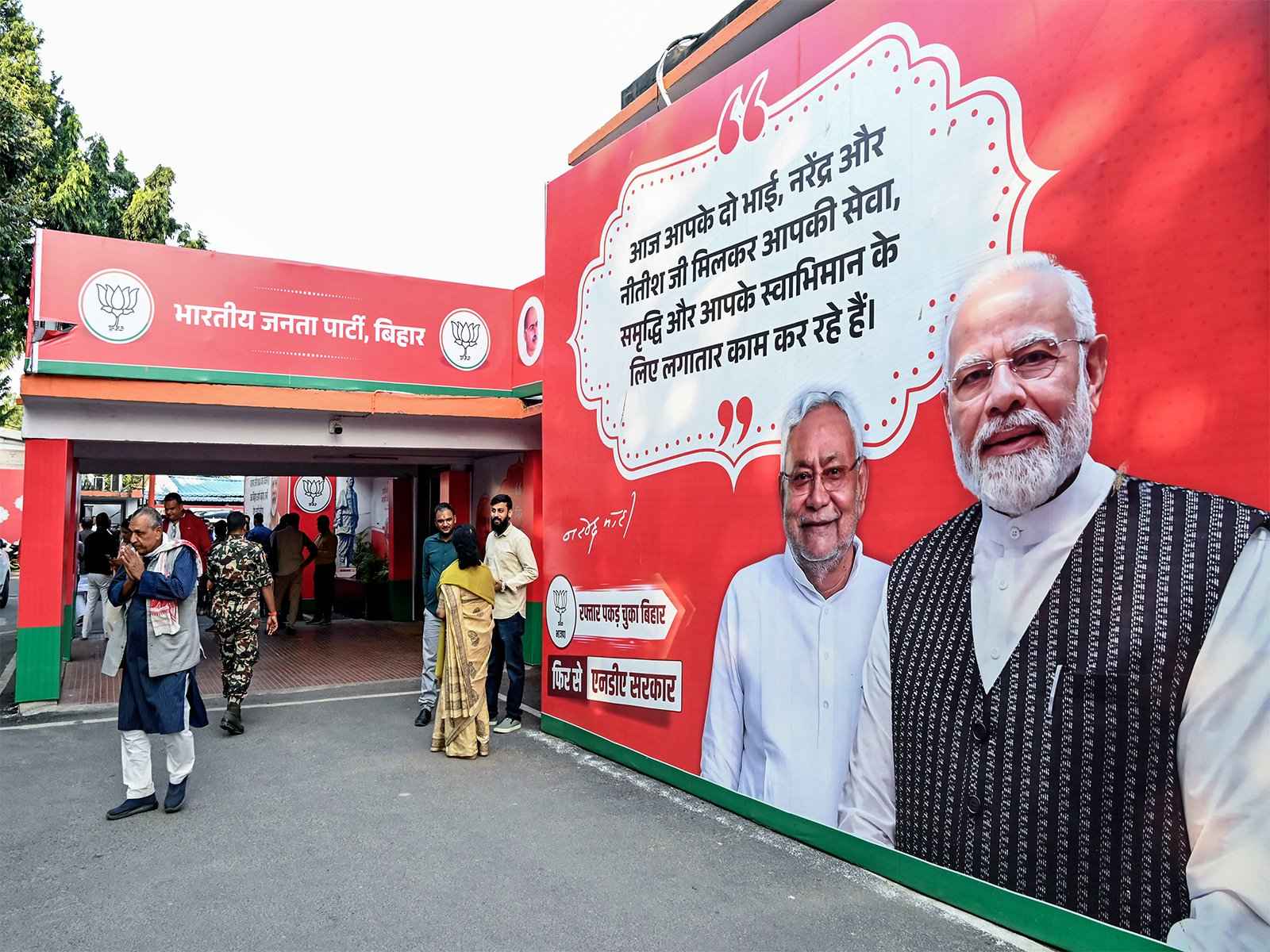
The ruling National Democratic Alliance (NDA) in Bihar has crossed the 122-mark, while the opposition Grand Alliance is lagging behind, according to the Election Commission of India.
As per the lead on 229 seats, NDA is leading on 167 seats, Bharatiya Janata Party is leading on 71 seats and Chief Minister Nitish Kumar-led Janata Dal (United) is leading on 72 seats. Chirag Paswan’s LJP (RLD) is leading on 18 seats.
BJP and JD(U) have maintained high conversion rates of 67 per cent and 64 per cent respectively.
The Grand Alliance is lagging behind with a lead of only 60 seats. Tejashwi Yadav’s Rashtriya Janata Dal (RJD) is leading on 43 seats, but the performance of its allies has been disappointing in the initial trends.
The Congress is leading on 8 seats, while the Communist Party of India (Marxist–Leninist) Liberation is leading on six seats. Meanwhile, AIMIM is leading on two seats.
Among the prominent faces, Deputy Chief Minister Vijay Kumar Sinha and Samrat Chaudhary are leading from Lakhisarai and Tarapur seats respectively. BJP’s Mangal Pandey is leading in Siwan, while Grand Alliance’s chief ministerial candidate Tejashwi Yadav is leading in Raghopur.
Counting of votes for all 243 constituencies began at 8 am amid tight security. Officials have started counting of postal ballots, while counting of EVM votes will begin at 8:30 am.
Elaborate security arrangements have been made, with 4,372 counting tables and more than 18,000 counting agents monitoring the entire process. Most of the exit polls are predicting an easy victory for the NDA, while some are showing a victory for the Grand Alliance.
Counting of votes for all 243 constituencies began at 8 am amid tight security. Officials have started counting of postal ballots, while counting of EVM votes will begin at 8:30 am.
Elaborate security arrangements have been made, with 4,372 counting tables and more than 18,000 counting agents monitoring the entire process. Most of the exit polls are predicting an easy victory for the NDA, while some are showing a victory for the Grand Alliance.
According to the official press note of the ECI, 2,616 candidates and 12 recognized political parties participated in the polling held in two phases on November 6 and 11 and no one requested repoll in any constituency.
The main contest in Bihar elections is between the National Democratic Alliance led by CM Nitish Kumar and the grand alliance of Tejashwi Yadav.
In the 2020 election, the NDA gained majority in the assembly and won 125 seats, and Nitish Kumar again became the Chief Minister. However, in August 2022, Nitish Kumar broke the alliance with the BJP and resigned as Chief Minister, and formed the government with the RJD-Congress led grand alliance.
He emerged as a key figure in the formation of the United Opposition Party of India. However, Kumar’s love affair with the RJD lasted less than two years and in January 2024, ahead of the parliamentary elections, Kumar returned to the NDA.
The BJP has improved its position between the 2015 and 2020 elections. In 2015, it contested 53 out of 157 seats and in 2020 it won 74 out of 110 seats. Rashtriya Janata Dal has also performed well. In 2015, it contested 80 seats out of 101 and in the 2020 elections, it fielded candidates on 144 seats, out of which it won 75 seats.
JD-U’s performance witnessed a decline in the last two elections. In 2015, it contested 101 seats, winning 71, and in 2020, it won 43 out of 115 seats. The Congress’s performance also saw a decline, falling from 27 seats in 2015 to 19 in 2020.
Voting for the Bihar Assembly elections was held in two phases, on 6 November and 11 November.
This time the Bihar Assembly elections created many records, with the highest turnout in both the phases. Bihar recorded a record 68.76% turnout in the second phase of voting, the highest in the history of the state. The total voting percentage of both the phases was 66.91%.
According to the Election Commission, this is the highest turnout in the state since 1951. There was 65.06% voting in the first phase. The main electoral contest in Bihar elections is between the National Democratic Alliance and the Grand Alliance.