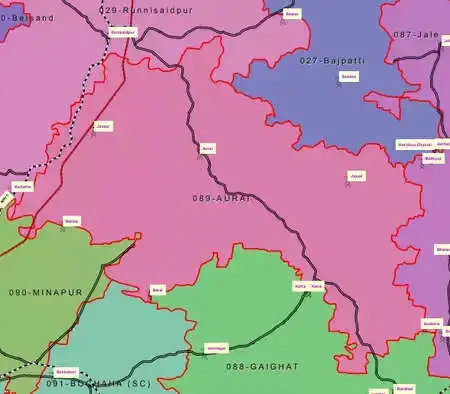
Patna, October 24 (IANS). Aurai assembly seat in Muzaffarpur district of Bihar is counted among those areas where the equation changes in every election. This assembly is a general category seat, which includes 16 gram panchayats of Aurai and Katra blocks.
This area is located about 30 kilometers north of Muzaffarpur city and extends up to the northern border of the district. Its geography extends to the border of East Champaran. Most of Aurai falls in the flood-prone valleys of the Gandak and Bagmati rivers, where floods affect rural life and farming every year. The fertile alluvial soil makes the area suitable for agriculture. This is why the economy here mainly depends on the cultivation of paddy, maize and vegetables. Animal husbandry is also an important source of income for the local people.
Geographically, Aurai is connected to Muzaffarpur by road. Major nearby cities include Sitamarhi (45 km), Darbhanga (65 km), Samastipur (70 km) and Motihari (75 km). The capital Patna is located about 95 kilometers south-west of here.
Aurai assembly seat was formed in 1967 and since then elections have been held 15 times, including the 2009 by-election. So far, Janata Party and JDU have won this seat thrice each. At the same time, Congress, Janata Dal, BJP and RJD have won twice each. In addition, the United Socialist Party has also achieved success once.
The election results of this seat make it clear that the voters of Aurai have never shown permanent loyalty towards any one party, but have voted on the basis of equations changing from time to time.
Since the by-election held on this seat in 2009, there has been a direct contest between BJP’s Ram Surat Rai and RJD’s Surendra Kumar Yadav. Surendra Yadav had won the by-election in 2009, but in the 2010 assembly elections, Ram Surat Rai defeated him and won the seat. In 2015, RJD won this seat in its favour. However, in the 2020 elections, Ram Surat Rai made a comeback and won again. From the election results of the last decade, we can say that the politics of Aurai has revolved around only two faces.
Talking about political equations, Yadav, Brahmin, Bhumihar, Musahar and Kushwaha communities have a decisive role in this region. Yadav and Muslim voters traditionally favor RJD, while Bhumihar and Brahmin voters lean towards BJP. Also, JDU has a hold among Dalits and backward classes.
This assembly constituency is facing many challenges on the development front. Every year, floods from the Gandak and Bagmati rivers devastate rural areas, affecting both farming and transportation. Irrigation systems are weak, roads are bad and health services are limited. Lack of employment and education opportunities is also a big issue for the youth. The biggest demands of the public are permanent flood solutions, better health facilities and expansion of road connectivity to villages.
According to the Election Commission data for 2024, the region has a total population of 5,39,688, which includes 2,83,745 males and 2,55,943 females. At the same time, the total number of voters is 3,20,357. This includes 1,70,342 men, 1,50,006 women and 9 third gender voters. Due to its rural nature, politics here revolves around agriculture, floods and caste equations.
–IANS
PSK/ABM