Meaning of Nitish Kumar’s sudden departure from Bihar and son Nishant’s entry into politics
The new slogan of the ruling Janata Dal-United in Bihar, ‘A new dawn… Nishant’s face’ is enough to show that the end of the Nitish Kumar era in the politics of the state has begun. The new hope of the party is his son Nishant Kumar. Nishant has formally accepted primary membership of the party. JDU’s new social media post says, “The debut of Nishant Kumar ji in the politics of Bihar with young thinking and strong determination is like a new dawn. The simplicity of Engineer Nishant Kumar ji connects everyone. His sensitivity worries everyone. This is the innate quality of leadership, which is visible in the personality of Nishant ji.” Obviously, Nishant has been made a primary member of JDU, so that after Nitish Kumar leaves the post of Chief Minister, he can join the party without any trouble. Can take command of leadership in their hands.
It is a different matter that leave alone assuming leadership, Nishant has no interest in politics and he has always maintained distance from it. During his father’s 20-year tenure as Chief Minister, he was hardly seen at public events. Even if he did appear, he always firmly stated that he had no intention of entering politics. Nitish, who has always raised his voice against nepotism in politics, has himself said many times that none of his family members have any connection with politics.
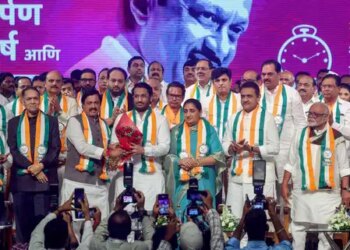
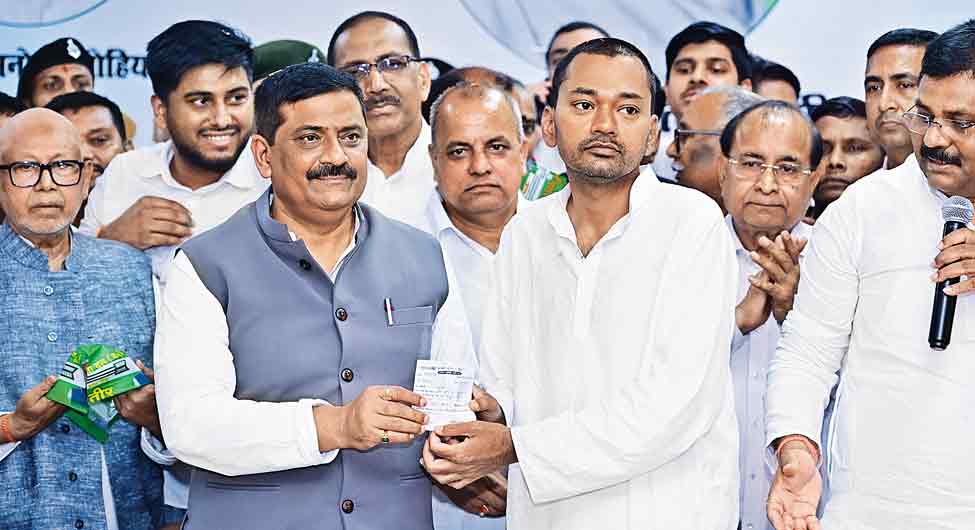
But it seems the situation has changed now. Nishant not only became an active member of JDU, but is also being “prepared” to take up important responsibilities in the new cabinet to be formed after Nitish’s resignation in the coming days. After taking the membership slip from the party’s working national president Sanjay Jha on March 8 at the JDU office in Patna, the way for his coronation in Bihar politics has been cleared. JDU believes that “Nishant Kumar ji’s political journey with youthful energy, clear thinking and strong determination to serve the public is a symbol of new hopes and new faith in Bihar.”
With this step, the party’s message is clear to the divided leaders and workers. This also resolved the old issue of speculation that had been going on for years, which kept coming up again and again in the form of questions like whether Nitish would die after Nitish, whether it would be from his party or his family.
Nitish filing Rajya Sabha nomination in the presence of Amit Shah
For those who have not been closely following the politics of Bihar in recent years, Nishant’s membership of the party may be a matter of surprise. The reason is that neither Nitish nor Nishant himself ever expressed any desire or intention to hand over the command of the party to a family member. Therefore, whenever it came to the possible successor of Nitish, speculations were made on different names at different times. Former IAS officer R.C.P., who was once his principal secretary for a long time. Singh’s name used to come up and sometimes Prashant Kishore’s. But later, both of them parted ways with Nitish. In recent times, the name of another former IAS officer Manish Verma, Nitish’s compatriot, who had joined JDU after taking voluntary service leave, has also emerged.
But, the question of Nitish’s succession remained a complex one for the party as a unanimous decision could never be taken on the name of any leader. During Nitish’s tenure, one of the leaders closest to him was the current working president of the party, Sanjay Jha. Sanjay, once a confidant of BJP leader Arun Jaitley, left BJP and joined JDU on the insistence of Nitish. Apart from him, Rajeev Ranjan alias Lalan Singh and Vijay Kumar Choudhary are in Nitish’s ‘inner circle’. Although these three leaders come from the upper caste community, the chances of these people becoming Nitish’s successors were negligible. There was less hope of maintaining unity in the party even on the names of other leaders coming from extremely backward or OBC category like Vijendra Prasad Yadav, Shravan Kumar or Ashok Choudhary. Obviously, it was for these reasons that Nishant was brought forward so that the ’emotional factor’ of being the son of the party supremo would prove effective in maintaining party unity.
However, more surprising than Nishant’s sudden entry into politics was Nitish’s decision to leave the post of Chief Minister. Just four months ago, under his leadership, the NDA had won a landslide victory in the Bihar assembly elections and his party had fought the elections with the slogan “Pachis se thirty, again Nitish”. This was the reason why when Nitish expressed his desire to go to Rajya Sabha on ‘X’, his supporters were surprised. Some supporters staged a protest outside his residence, some angrily vandalized the party office and raised slogans against leaders close to Nitish, saying they had conspired with the BJP to remove Nitish from the post of chief minister.
In fact, in the last two Bihar assembly elections, BJP emerged as the largest party in the NDA. The decision of the alliance’s other constituent, Chirag Paswan’s Lok Janshakti Party, to contest independently in the 2020 assembly elections was termed by JDU leaders as a conspiracy by the BJP. He had alleged that BJP wants to gain the post of Chief Minister by deliberately weakening Nitish. In that election, JDU was reduced to just 43 seats and BJP won 31 more seats than that. Keeping in view the public opinion, Nitish had expressed his desire to leave the post of Chief Minister after that election, but BJP did not agree at that time. However, there is no doubt that BJP has been wanting to form a government under its leadership in Bihar for a long time. Now that Nitish is going to Rajya Sabha, there are speculations that BJP will accept power for the first time in Bihar only after blooming the lotus.
The question is that if BJP accepted Nitish as the Chief Minister despite winning 31 seats more than JDU in 2020, then why did Nitish decide to step down in 2025 when the gap between BJP (89) and JDU (85) was just four seats? In fact, in the last election, Rashtriya Janata Dal had won 75 seats and Congress with its allies and Nitish’s 43 seats could easily achieve the figure of 122 for majority. Considering Nitish’s track record of changing sides, BJP could not take any such risk at that time, which could backfire. This time RJD was reduced to only 25 seats while BJP without JDU along with its remaining allies Chirag (19), Jitan Ram Manjhi (5) and Upendra Kushwaha (4) was just 5 seats away from the majority mark.
Obviously, it was not difficult for the BJP to “arrange” these five seats. Nitish and his close leaders knew this very well. Apart from this, there was also the issue of Nitish’s deteriorating health. Therefore, the leaders of both the parties agreed on the decision of sending Nitish to Rajya Sabha. However, if the BJP wanted, it could have staked claim for the post of Chief Minister even after the 2025 election results, but the entire election was fought under the leadership of Nitish and the BJP did not want to take any such decision which would lead to a bitter parting of ways with Nitish and would send a wrong message to the public.
The political capital that Nitish has earned in the last two decades in Bihar politics, BJP did not want to lose that legacy in its eagerness to make him its Chief Minister. In this way, with the new equation neither the stick will be broken nor the snake will also be destroyed.