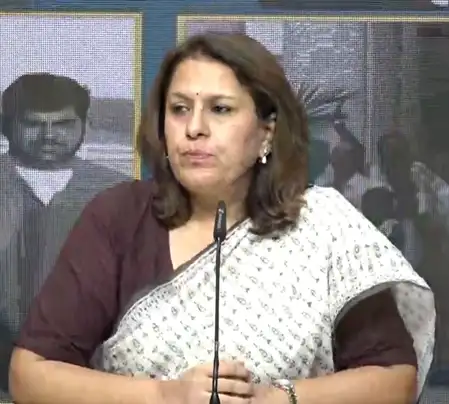
New Delhi, June 15 (IANS). Welcoming the peace agreement between America and Iran, Congress leader Supriya Srinet made a sharp attack on the foreign policy of the central government. He said that peace-building initiatives anywhere in the world should be welcomed because civilians, women and children pay the biggest price for wars and conflicts.
Congress leader Supriya Shrinate said that three Indian citizens lost their lives in the attacks during the US-Iran conflict. He claimed that the deaths of Indian citizens, including Aditya Sharma, Patnaik and Suresh Chaurasia, were caused by US action, but the Prime Minister neither expressed condolence nor condoled the victims’ families.
He alleged that the Indian government also failed to hold America accountable. The Congress leader said that when this issue was raised with the US, there was no apology expressed by US Secretary of State Marco Rubio. Along with this, the Indian government failed to present its views effectively in this matter.
Shrinet also raised questions on India’s role in the US-Iran peace deal. He said that despite India being an important global power, it was nowhere visible in this entire process, while the role of a country like Pakistan is being discussed. He asked why India did not participate in this important diplomatic initiative?
He said that after independence, Pandit Jawaharlal Nehru adopted an independent foreign policy without coming under the influence of any superpower. Former Prime Minister Indira Gandhi gave priority to national interests despite American pressure. Referring to the Indian diplomat Devyani Khobragade episode during the tenure of former Prime Minister Dr. Manmohan Singh, he said that at that time India had adopted a tough stance, after which America had to express regret.
Supriya Shrinet alleged that former Prime Ministers always kept the country’s sovereignty and honor paramount, while the current government is adopting a more soft stance towards America. He said that self-respect and independence should be supreme in the country’s foreign policy.
–IANS
SAK/ABM