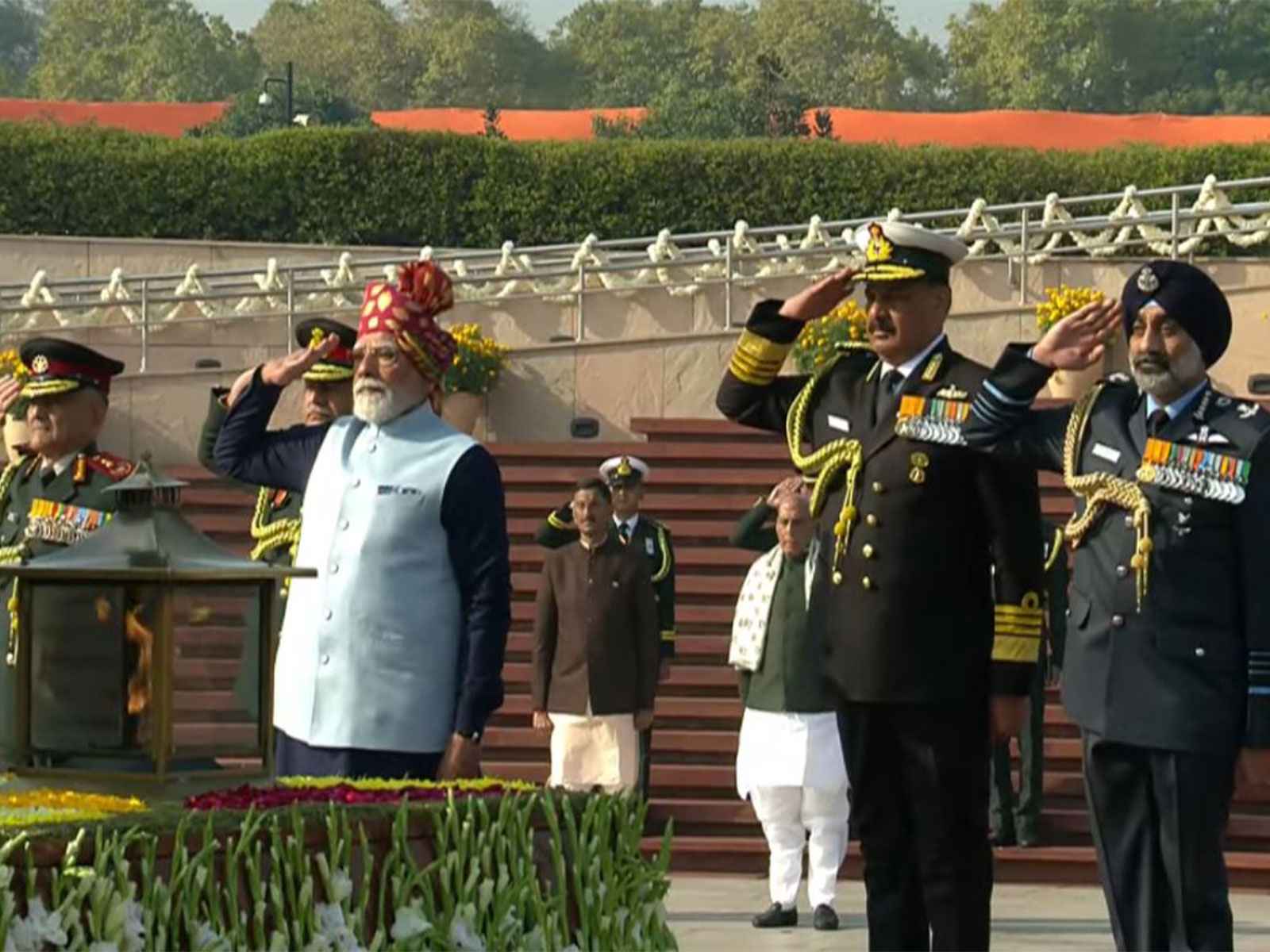
Republic Day celebrations have started in the capital. Today, first of all, Prime Minister Narendra Modi paid floral tributes at the National War Memorial located at the historic India Gate. The Prime Minister was also accompanied by Defense Minister Rajnath Singh, Defense Services Chief General Anil Chauhan, Army Chief General Upendra Dwivedi, Air Force Chief Air Chief Marshal APS Singh and Navy Chief Admiral Dinesh Tripathi.
The Republic Day celebrations begin with the laying of floral tributes and is a tribute to those personnel who made the supreme sacrifice.
The inter-service guard was present at the ceremony, consisting of 21 internal guards, including seven from each service, and six buglers, including two from each service. The Indian Air Force’s Internal Guard consisted of one sergeant and six corporals and below.
The Indian Air Force being the premier service, the Guard of Honor was commanded by Squadron Leader Hemant Singh Kanyal, reflecting the united spirit of the Indian Defense Forces.
After laying the wreath, the Guard Commander ordered the salute and then the condolence. The solemn tune of ‘Last Salute’ echoed throughout the complex as the uniformed officers gave the salute, while everyone else stood respectfully at attention.
Two minutes silence was observed in honor of the brave warriors. At the end of the silence the buglers played the tune of ‘Rouse’. The Guard Commander once again ordered the salute, formally concluding the ceremony.
Prime Minister Modi along with other dignitaries headed towards the salute stage to continue the Republic Day celebrations.
This morning, Prime Minister Modi extended greetings on the 77th Republic Day and urged citizens to renew their commitment towards a ‘developed India’.
In a post, Prime Minister Modi said, “Warm greetings on Republic Day. May this national festival, a symbol of India’s pride and honour, infuse new energy and enthusiasm and strengthen the resolve for a developed India.”
Republic Day, celebrated annually on 26 January, marks the day India adopted its Constitution in 1950 and officially became a sovereign, socialist, secular and democratic republic. This day is extremely important from a historical point of view as it marks the culmination of India’s freedom struggle and the establishment of constitutional governance based on justice, liberty, equality and fraternity.
Today President Draupadi Murmu will preside over the grand function organized at the Duty Path in New Delhi. European Council President Antonio Costa and European Commission President Ursula von der Leyen will be present as chief guests on this special occasion.
This year, the duty path stretching from Rashtrapati Bhavan to the National War Memorial has been lavishly decorated to showcase India’s remarkable journey.
According to a release issued by the Defense Ministry, the ceremony will witness an extraordinary blend of the 150-year-old heritage of the national song Vande Mataram, the country’s unprecedented developmental progress, strong military might, vibrant cultural diversity and active participation of citizens from all walks of life.
The celebrations will begin with Prime Minister Narendra Modi’s visit to the National War Memorial, where he will pay tribute to the martyrs by paying floral tributes. After this, the Prime Minister and other dignitaries will proceed to the salute platform on the duty path to watch the parade.
The President of India, the President of the European Council and the President of the European Commission will arrive in a traditional buggy, accompanied by the President’s Body Guard, the most senior regiment of the Indian Army. As per tradition, the national flag will be hoisted, followed by the national anthem and a 21-gun salute from the indigenously developed 105 mm Light Field Gun. This salute will be given by 1721 Ceremonial Battery of 172 Field Regiment.
A total of 30 tableaux – from 17 States/UTs and 13 Ministries/Departments/Services – will participate in the parade based on the overarching theme of ‘Mantra of Freedom: Vande Mataram’ and ‘Mantra of Prosperity: Self-reliant India’.
These tableaux will present a unique blend of 150 years of the national song Vande Mataram and the rapid progress made on the back of growing self-reliance in various sectors, steeped in the country’s rich and vibrant cultural diversity.