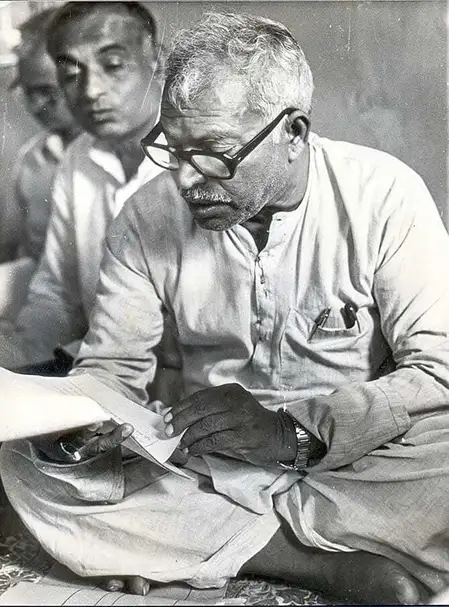
New Delhi, January 23 (IANS). “The present government has failed to stop the riots. As far as the troubles faced by Harijans, tribals and weaker sections are concerned, don’t ask anything. Like a poor tongue living between 32 teeth, they are living under this rule.” There has been a long tradition of exploitation and exploitation in the society, but these ideas of Karpoori Thakur, the great warrior for the interests of the helpless and exploited class, are the foundation of social justice even today. These words of his continued to resonate from the Musahar group of Bihar to the Legislative Assembly for almost half a century.
The life journey of the messiah of the poor, who became the voice of millions of voiceless people, began on 24 January 1924. He was born in Pitaunjhiya village (now Karpoori village) in Samastipur district of Bihar. The official website for the Padma Awards mentions Karpoori Thakur’s early life as follows:
The family was socially, educationally and politically backward in the caste-ridden society of foreign-ruled India. He would stand in the hot sun outside the huge mansions of the landlords and acquire the knowledge of the textbooks by listening to the lessons being taught to the underprivileged children inside the mansions. He was among the few to pass the 10th class board examination at that time. Facing social and economic challenges, he got admission in the prestigious CM College.
After doing intermediate, nominal college education from C.M. College in Darbhanga, because his higher education remained incomplete due to his involvement in the freedom movement. While being a college student, Karpuri started taking part in the freedom struggle in 1942 on Mahatma Gandhi’s call of ‘do or die’. The saga of struggle that started with the freedom movement became an integral part of Karpoori ji’s life. From here the struggle for the social, economic and political upliftment of Dalits, backward classes, exploited people and the poor started.
‘We have come to awaken the sleeping country, we have come to revive dead hearts.’ Karpoori Thakur had not just inscribed it with dark ink on blank pages, but had assimilated it in life. Bhim Singh writes in his writing ‘Guddi Ke Lal: Personality and Works’, “On the one hand, Karpoori Thakur’s personality was influenced by Mahatma Gandhi, on the other hand, he was also greatly influenced by Netaji Subhash Chandra Bose.
Under the leadership of socialist leaders like Loknayak Jaiprakash Narayan, Ram Manohar Lohia, Acharya Narendra Dev and Pandit Ramnandan Mishra, Karpuri’s role in the socialist movement was becoming visible and with it his courage was rising to greater heights. Movements like ‘Quit India’ further strengthened Karpoori Thakur, in which he not only actively participated but also had to be arrested in 1943. He did not leave the path of struggle even after his release from jail in 1945. He continued his non-violent struggle against the British Raj and in the interest of landless farmers.
When Karpuri Thakur had set the example of struggle, a poet had written, “That man, who is surrounded by the crowd, is mad in the eyes of many. That man, who is surrounded by the crowd, is not actually God, but the soul of the crowd.”
He had become a unique leader not only of Bihar but also of the country. In many ways he had become a man of rare qualities. For those who saw Karpoori Thakur, this was the shadow of Karpoori Thakur’s great personality.
Politics was not his main inspiration. His main motivation was service to the public, which he never let go away from his life. In future, even though he had set the path to the assembly by winning from Tajpur in 1957 and 1962, and later became the Chief Minister of Bihar twice, but he made politics a medium of service and not of earning money.
In an interview with Prasar Bharati, a person who closely observed him said, “Even when he was the Chief Minister, his chamber was full of poor people. Due to which the officers also started getting worried. The officers used to say that the poor people used to sit in the Chief Minister’s room.”
He told an anecdote that one day he himself had gone to the Circuit House. When Karpoori Thakur started eating food there, he also invited all the lower category employees for food. He had dinner sitting with everyone. At that time a collector had said that what a farce is this that everyone will have dinner with the Chief Minister. I told the Collector that when the Chief Minister wants to eat with everyone, then whom can you stop. Later I went and complained to Karpoori Thakur.
This was the reason why Karpoori Thakur always got the love of the people. Whatever position Karpuri Thakur held, he treated everyone with equal respect, irrespective of religion or caste. Because of his selfless service and unwavering love for the poor, people affectionately called him ‘Jananayak’.
–IANS
DCH/DSC