In 1997, Bihar Chief Minister Lalu Prasad Yadav adopted a highly planned and dramatic strategy to avoid his possible arrest in the fodder scam and maintain his family power in Bihar. Under this strategy, he made his wife Rabri Devi the Chief Minister of the state. This step was in a way taken by him to prioritize the interests of the family, in which his main objective was not to let the power go with his own hands. This decision took a new turn in Bihar politics and the process of becoming the Chief Minister of Rabri Devi proved to be helpful in changing the political perspective of the entire state.
Lalu Prasad Yadav, who became the Chief Minister of Bihar in 1990, made a strong identity among the poor and backward. His government launched several schemes, but at the same time allegations of corruption and scam started tarnishing his image. In 1993, when Leader of the Opposition Sushil Modi alleged that the matter started increasing from the Animal Husbandry Department. Along with this allegation, the case of unaccounted withdrawal of government money from Ranchi Treasury increased his difficulties. These cases put him in political crisis. After the 1996 general elections, Lalu created a new identity as the national president of the Janata Dal and dreamed of becoming Prime Minister. But in January 1997, the CBI called him for questioning in the fodder scam case, causing the danger of his arrest. Subsequently, on 17 June 1997, Governor AR Kiddwai gave permission to file a charge sheet in the court against 55 people including Lalu.
When the CBI was in danger of arrest, Lalu decided to make his wife Rabri Devi the Chief Minister. Following the advice of Radha Nandan Jha, he ensured support from the Congress and sent a message to the CBI to postpone the arrest. After resigning on 25 July 1997, he declared Rabri Devi as the successor of the Chief Minister. This step was taken by Lalu to keep his family in power, so that the voice of any opponent could be suppressed.
Soon after resigning, Lalu called a meeting of MLAs and only said, “We have chosen Rabri.” The legislators replied in one voice, “G have cured sir”. Lalu Yadav cleverly put forward the name of Rabri Devi, so that any protest could be suppressed. According to media reports, Lalu took the step in such a way that there was no scope to protest in it. In a meeting full of his brother -in -law Sadhu Yadav, Lalu handed over the key of power in his family’s hands.
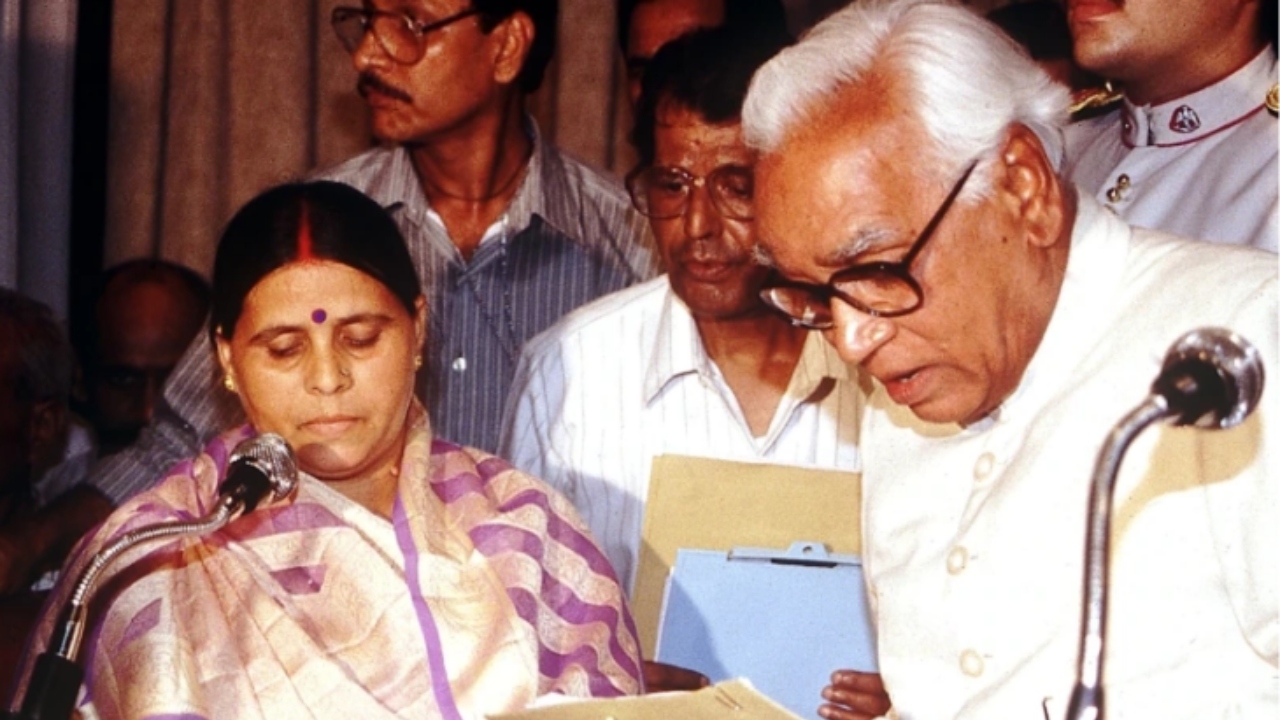
Rabri Devi, who was not ready to become the Chief Minister herself, was suddenly forced to sit on the post of Chief Minister. His scene was very emotional and dramatic during the swearing -in. It is said that Rabri Devi was emotional and she rarely imagined that she would become the Chief Minister. The red nail in the fingers of his toes was disturbed even after the polish. When Rabri Devi took oath from the governor, many people were laughing at him, and Lalu jokingly said “Ton tons will speak from tomorrow”.
Rabri Devi never hid that it was not her wish to become the Chief Minister. She always obeyed her husband’s command. Despite becoming the Chief Minister, she did not stop making morning tea for kitchen work and Lalu. The opposition made fun of Rabri Devi’s naivety, but it became clear that the real center of Bihar’s power was still Lalu Yadav. His government was known as ‘Jungle Raj’, and Rabri Devi’s tenure was seen in a way as a ‘rubber stamp’.
After Rabri Devi became the Chief Minister, efforts were made to remove her government twice. In 1999, the government of Atal Bihari Vajpayee, while talking about ‘Jungle Raj’, demanded the implementation of President’s rule in Bihar. The central government appointed Sundar Singh Bhandari as the Governor and tried to impose President’s rule in the state. However, Lalu stopped President’s rule by aligning with Congress. No party could achieve a clear majority in the 2000 elections. An attempt was made to make Nitish Kumar the Chief Minister, but he could not run his government within 7 days and Rabri Devi again became the Chief Minister.
Lalu Yadav’s cleverness and political skills made Rabri Devi the Chief Minister, and maintained the power of the family in Bihar politics. Rabri Devi’s tenure was surrounded by controversies, but it was also true that the real Shakti remained in Lalu’s hands during this time. By 2005, Rabri Devi’s term proved to be the tenure of the third longest Chief Minister in Bihar. In this way, this trick of Lalu Yadav became a historical event in Bihar politics.