New Delhi, December 17 (IANS). Opposition members came under strong criticism during the discussion on the Develop India – Employment and Livelihood Mission (Rural) Bill, 2025 in the Lok Sabha. The bill seeks to repeal the Mahatma Gandhi National Rural Employment Guarantee Act (MNREGA), 2005, and introduce a new rural employment framework that will guarantee 125 days of paid work annually, up from the earlier 100 days.
Union Agriculture and Farmers Welfare Minister Shivraj Singh Chouhan introduced this bill amid protests on December 16. The bill is in line with the “Develop India 2047 vision”, which focuses on thematic infrastructure such as water security, rural connectivity and climate resilience, along with better digital monitoring and synergy of schemes.
DMK MP K. Kanimozhi strongly opposed the name of the bill, saying that she gets ‘angry’ after reading its name. He said, “This is nothing but the imposition of Hindi on non-Hindi speaking states. The central government keeps finding ways to impose Hindi or Sanskrit on regional states again and again.”
Echoing the same sentiment, Trinamool Congress MP Mahua Moitra accused the government of communalising the scheme by taking the name of Lord Ram. He said, “Why is the name being changed? It makes no sense. They are communalising it by bringing the name of Lord Ram.”
He further said, “This is not for Ram or Rahim.”
Moitra also demanded release of pending MNREGA funds for West Bengal, and alleged that the Center was now canceling the bill altogether after withholding the dues.
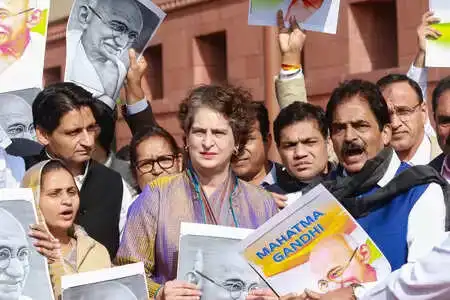
While praising the role of MNREGA in generating large-scale employment in rural areas since 2005, opposition members, including Congress leaders like Priyanka Gandhi, protested against the removal of Mahatma Gandhi’s name, calling it an “insult” to the Father of the Nation, and called for a nationwide agitation.
In contrast, TDP MP Lavu Sri Krishna Devarayalu supported the bill, calling it “yet another rehash” of pre-2005 schemes like the Jawahar Rojgar Yojana.
“It’s basically the same with a few changes,” he said, welcoming the increase to 125 days as a positive step.
The bill introduces changes like 60:40 Centre-State funding (90:10 for North-Eastern/Himalayan states), seasonal block during peak farming season and common allocation.
While the government is defending it as a way to modernize rural livelihoods, opponents fear a reduction in rights-based guarantees and additional burden on states.
–IANS
AMT/DKP