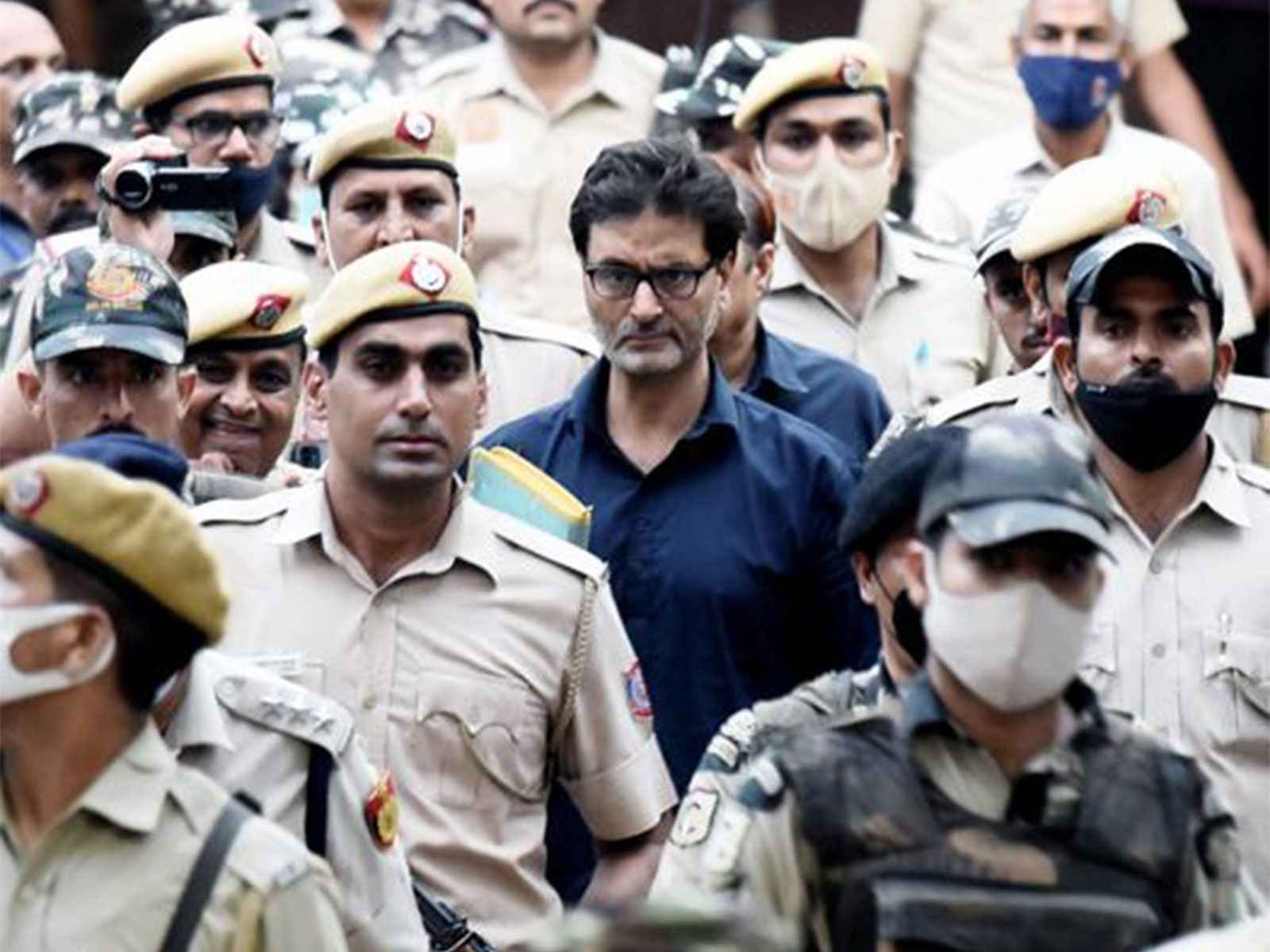
Jammu and Kashmir Liberation Front (JKLF) chief Yasin Malik has told the Delhi High Court that after meeting Hafiz Saeed in Pakistan in 2006, he had given personally information to the then Prime Minister Manmohan Singh and the then National Security Advisor NK Narayanan, yet the same meeting was later dismissed and declared a terrorist.
Malik, who is serving a life imprisonment in the case of financing terrorism, filed an affidavit claiming that a meeting with Saeed and other leaders took place at the request of India’s Intelligence Bureau (IB) during his visit to Pakistan for earthquake relief work.
Malik said, “Despite working to strengthen peace talks, my meeting was later distracted and called me a terrorist.”
He described it as a case of “classic betrayal”.
He alleged that after canceling Article 370 and 35A, the 2006 meeting was shown out of the context to justify the UAPA against them, while they had openly interacted and reported to India’s top leadership.
Malik also said in his affidavit that if he was given the death penalty, he is ready to face it.
He wrote, “If some people finally get relief from my death, then I will go with a smile, but my face will be proud and respected.”
He compared himself to Kashmiri separatist leader Maqbool Bhat, who was hanged in 1984. He described death as the “final stop” of his struggle. And quoted Shakespeare: “Get completely devoted to death; because either death or life will be more sweet.”
This affidavit comes at a time when the Delhi High Court is hearing the appeal of the National Investigation Agency (NIA) that has demanded death sentence by extending Malik’s life imprisonment in the 2017 terror funding case. The bench has asked Malik to file his reply by 10 November.
In 2022, Malik was sentenced to life imprisonment after being convicted under the illegal activities (prevention) Act (UAPA). The lower court had admitted that its case did not fall in the “rare to rare” category to give death penalty.
In the case of NIA, others including Malik and Hafiz Saeed, Syed Salahuddin and Shabbir Shah were accused of conspiring with Pakistani groups to create unrest in Kashmir.
Meanwhile, the UAPA Tribunal has recently extended the ban on JKLF for five more years, saying that no tolerance can be shown to organizations advocating separatism.