Kathmandu, February 3 (IANS). Nepal’s interim government on Tuesday decided to withdraw the social media bill pending in Parliament. This bill was passed by former Prime Minister K.P. Sharma was introduced by the Oli-led government and was facing widespread criticism over allegations of limiting freedom of expression.
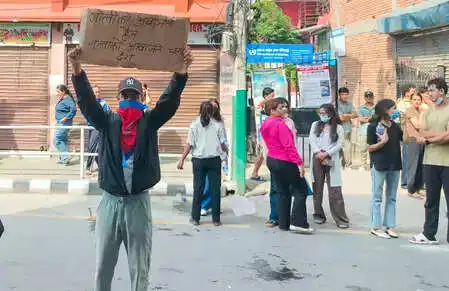
The decision comes in the backdrop of massive Gen-Ji-led protests against the ban on social media imposed by the Oli government in September. These protests later transformed into a broader anti-corruption movement, resulting in the ouster of the Oli government.
Government spokesperson and Home Minister Om Prakash Aryal told reporters that in the cabinet meeting it has been decided to withdraw the Social Media Bill from Parliament.
The objective of this bill was to regulate social media platforms. The government argued that the ‘Social Network Usage Management Guidelines’ implemented in the year 2023 are not sufficient.
In early September, the Oli government had banned several social media platforms – Meta (Facebook, Instagram, WhatsApp), Alphabet (YouTube), X (formerly Twitter), Reddit and LinkedIn – citing lack of registration under regulatory provisions.
However, there was intense youth-led protest against this decision, which later turned into an anti-government and anti-corruption movement. Despite this, the Social Media Bill introduced by the Oli government remained pending in the Upper House of Parliament, containing several provisions that were feared to curb freedom of expression.
Digital rights organisations, including the Nepal Journalists Federation, had strongly criticized several provisions of the bill. The most controversial sections included the provision related to punishment for misuse of social media.
The bill listed about a dozen offenses punishable with heavy fines and jail terms for users. Those spreading false or misleading information using fake identities could face the harshest penalties, including imprisonment of up to five years and a fine of up to 1.5 million Nepalese rupees.
The bill also stated that no person can use pseudonym or temporary identity for the purpose of spreading false or misleading information against the sovereignty, territorial integrity or national interest of Nepal.
Apart from this, there was a proposal to make it mandatory for social media platforms to obtain a government license. A fine of up to 25 lakh Nepali rupees was fixed for operating without a license.
The bill also provided for strict punishment for cyber bullying, skimming, phishing, identity fraud, sextortion and other crimes committed through social media.
–IANS
dsc