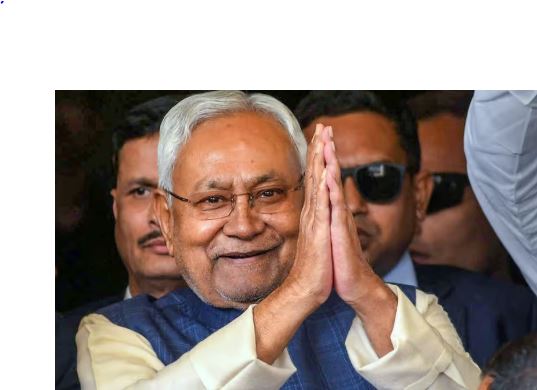
In his political career spanning nearly 50 years, Nitish Kumar has shown the amazing ability to rise again like a ‘phoenix’ every time he faces doubts and criticism.
Nitish Kumar, who stood out among the leaders emerging after Mandal politics, showed efficiency in removing administrative shortcomings, whereas many leaders of his time lagged behind in this matter. Critics have often accused him of practicing politics of opportunism.
Call it political opportunism or foresight, because of Nitish’s strategy, the Bharatiya Janata Party (BJP) has so far not been able to make its Chief Minister in the state, whereas at the national level the party is very strong and won 89 seats in the recent assembly elections, while the Janata Dal United (JDU) got 85 seats.
Kumar is among the 10 longest serving Chief Ministers of the country. He has been in power for a total of 19 years.
Due to his habit of changing political sides, critics and leaders of opposition parties started calling him ‘Paltu Ram’, while his popularity for good governance is also known as ‘Sushasan Babu’.
In last year’s Lok Sabha elections, his party JDU recorded a better ‘strike rate’ than BJP. Both won equal number of seats, while JDU contested one less seat. Due to lack of majority at the Centre, BJP is dependent on this alliance partner.
After completing his engineering studies and active participation in the JP movement, Kumar entered politics by rejecting a job in the state electricity department. His step was an unusual step considering the deep attraction towards government jobs among the youth of Bihar.
Despite being a companion of JP movement along with Lalu Prasad and Ram Vilas Paswan, he did not get electoral success for long.
He reached the Assembly for the first time in 1985 by winning from Harnaut as a Lok Dal candidate.
Four years later, he was elected MP from Barh Lok Sabha constituency, while Lalu Prasad, then MP from Saran, entered the politics of Bihar, taking over as the Chief Minister and rapidly rose to the top.
Over the next decade and a half, Lalu Prasad emerged as one of the most influential but controversial leaders of the state. After being named in the fodder scam, he resigned and handed over the post of Chief Minister to his wife Rabri Devi.
On the other hand, during the same period, Nitish Kumar distanced himself from Lalu, formed Samata Party and strengthened his political base. The Samata Party formed an alliance with the BJP and Kumar distinguished himself with his effective style of functioning in Parliament.
Due to differences between Sharad Yadav, who was the president of Janata Dal, and Lalu Prasad, Lalu formed Rashtriya Janata Dal (RJD). Samata Party later merged with Sharad Yadav’s Janata Dal and its alliance with BJP continued.
The victory in Bihar gave fresh strength to the BJP-JDU alliance after the National Democratic Alliance (NDA) lost power at the Center in 2004.
After the February 2005 assembly elections, the NDA missed the majority. At the Centre, too, the NDA’s efforts to gain power in Bihar from the ruling RJD-Congress alliance hit a wall when the then Governor Buta Singh took the controversial decision to dissolve the Assembly in view of the alleged horse-trading of MLAs.
However, this decision proved crucial for Kumar and in the elections held nine months later, the JDU-BJP alliance got a majority and the ‘Lalu era’ came to an end. Nitish Kumar’s first five years as Chief Minister are remembered for improvements in law and order.
Coming from a less populous caste group than Lalu, Kumar created new social equations by creating categories like backward class and Mahadalit. Schemes like providing bicycles and dresses to school girls brought him a massive majority in 2010.
After Narendra Modi was made the head of BJP’s election campaign committee in 2013, Nitish broke the 17-year-old alliance with BJP.
Despite winning the trust vote with the support of Congress, he resigned taking moral responsibility for JDU’s poor performance in the Lok Sabha in 2014. In less than a year he again became the Chief Minister. This time he assumed power with the support of RJD and Congress by removing his once confidant Jitan Ram Manjhi from the post of Chief Minister. This grand alliance won the 2017 elections, but broke up two years later due to differences over the alleged corruption case against Tejashwi Yadav.
Kumar resigned from the post of Chief Minister and in less than 24 hours became the Chief Minister again with the support of BJP. In 2022, he ended the alliance accusing BJP of breaking JDU and formed a new opposition alliance ‘India’ with RJD, Congress and Left parties. However, amid speculations that this front was not given due importance, he left it too and the NDA accepted him back with an open heart.
(With PTI inputs)