
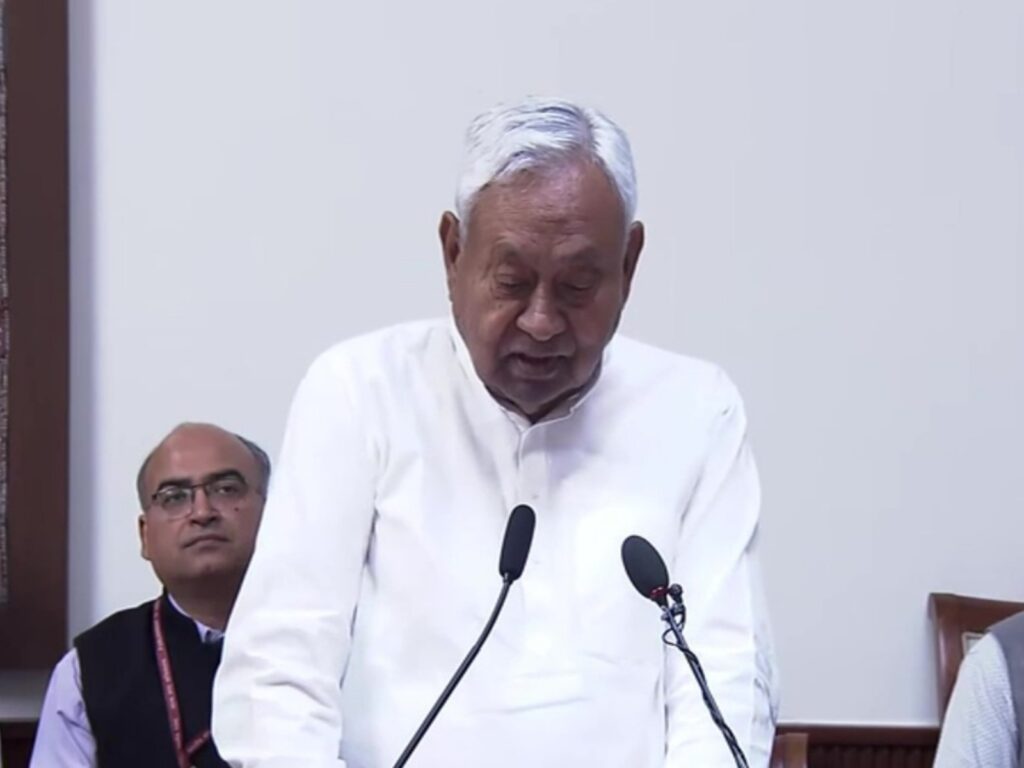
Veteran leader Nitish Kumar took oath as Rajya Sabha MP on Friday. His skill in coalition politics has been crucial for the National Democratic Alliance (NDA) to remain in power in Bihar.
Entering the Rajya Sabha marks the fulfillment of Kumar’s long-expressed desire to serve in every legislative house of India (Bihar Legislative Assembly, Bihar Legislative Assembly, Lok Sabha and finally the Rajya Sabha).
After being elected to the upper house of the Parliament, Kumar resigned from the membership of Bihar Legislative Council. Janata Dal (United) MLC Sanjay Gandhi submitted the resignation of the Chief Minister of Bihar to Council Chairman Awadhesh Narayan Singh.
This change of power effectively puts the reins of the Bihar government in the hands of the BJP, signaling a significant change in the power structure of the state ahead of the upcoming elections.
A high-level meeting of Bihar BJP leaders is also being held in Delhi today, in which the roadmap for the new state leadership will be finalized.
Nitish Kumar was elected to the Rajya Sabha on March 16 along with four other candidates fielded by the NDA from Bihar. Subsequently, Kumar was elected JDU president unopposed, as no other candidate had filed nomination for the post.
However, as per constitutional provisions, Kumar can remain the Chief Minister of Bihar for the next six months despite being elected as a Rajya Sabha MP. As per rules, it was mandatory for him to resign from the post of MLC within 14 days of being elected as MP.
Under Article 101 of the Indian Constitution, which deals with “vacancy of seats”, a person cannot be both an MLA/MLA and an MP. Clause (2) of the said article states that “No person shall be a member of both Parliament and a House of the Legislature of a State, and if a person is elected a member of both Parliament and a House of the Legislature of a State, on the expiration of such period as may be specified in rules made by the President, the seat of that person in Parliament shall become vacant, unless he has already resigned his seat in the Legislature of the State.”
The rules made by the President are referred to in the Concurrent Membership Prohibition Rules, 1950, which stipulate that if a member is elected to any other office, the time limit for resigning as a member of the State Legislature or Parliament shall be “fourteen days from the date of the announcement in the Gazette of India or the Official Gazette of the State, whichever is later published, that he has been so selected.”
Subsequently, as per the provision of the Representation of the People Act, 1951, the Election Commission of India (ECI) is obliged to hold by-elections to fill the vacant seat. In the case of Nitish Kumar and as per Section 151A of the Representation of the People Act, the by-election for the vacant councilor seat will be held within six months from March 30, the day Kumar resigned from the MLC post.
Earlier, BJP national president Nitin Nabin had clarified that there is no difference of opinion in the NDA regarding the appointment of the new Chief Minister of Bihar after Nitish Kumar is elected to the Rajya Sabha.
“There are no differences anywhere; everything is going as per schedule. BJP has always respected the coalition dharma, and that is why even today parties trust us. All decisions are being taken under the leadership of Nitish Kumar,” Naveen told ANI.
Nitish Kumar is the longest serving Chief Minister of Bihar. He started his political journey as an MLA in 1985 and later served as a Union Minister in the Atal Bihari Vajpayee government. Nitish Kumar became the Chief Minister of Bihar for the first time in 2005. He is one of the most experienced and senior political leaders of the country.