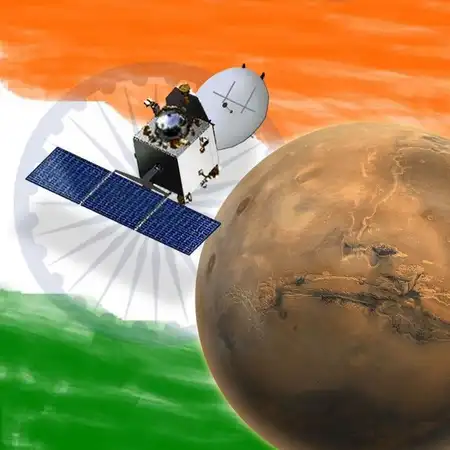
New Delhi, November 4 (IANS). Today, when we look at ISRO’s new heights, the first flight of Mangalyaan to the Moon, the Sun and beyond, comes as an inspiration. This is the golden age of India, where impossible is just a word, not a truth.
November 5, 2013, was the day India made a historic flight to Mars with the roar of rocket engines echoing in the skies of Sriharikota. This was the moment when ISRO not only touched space but also raised a sun of pride in the heart of every Indian. A history was written which was not just a technical victory, but a flight of dreams.
India’s first interplanetary mission to Mars, ‘Mars Parikrama Mission’ (MOM), was launched on 5 November 2013 by PSLV-C25.
The journey was not easy. The expedition faced challenges in its journey to Mars, as only less than half of the missions sent to this planet were successful. The next major challenge for this mission was to enter the orbit of Mars, as a test of the Japanese spacecraft in 2003 had failed when it suffered an electrical failure as it approached the planet.
After this, on 23 September 2014, this mission registered a big achievement for India. The Mars Orbiter Mission (‘Mangal Parikrama Mission’) had successfully entered the orbit of the red planet, creating history. With this, India became the country to enter Mars orbit in its first attempt. European, American and Russian spacecraft succeeded in orbiting or landing on Mars after several attempts.
The special thing about this success was that India became the first Asian and fourth country in the world to reach the orbit of Mars.
Its interesting story is also that ISRO’s first Mangalyaan was also the cheapest mission ever, so cheap that the cost of making the Hollywood film ‘Gravity’ was much more than this. This mission was prepared at a cost of about Rs 450 crore, which was the world’s most economical interplanetary mission.
This mission not only became a symbol of ISRO’s technical proficiency, but also gave India a new identity and prestige in the global space community.
This date of 5th November is recorded in golden letters in the history of India’s space science.
–IANS
DCH/ABM