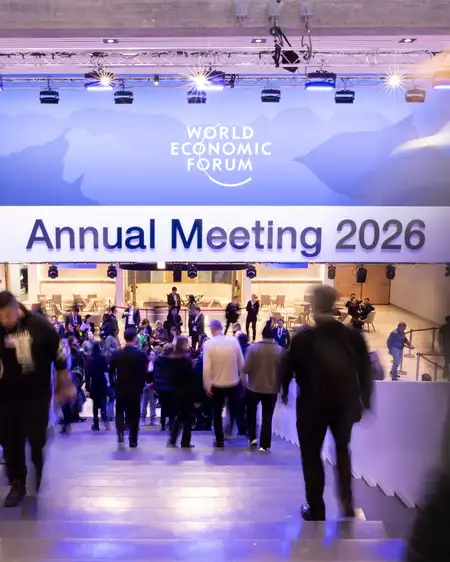
Davos, January 24 (IANS). The world’s most challenging issues were discussed at the 56th Annual Meeting of the World Economic Forum (WEF) 2026, held in Davos, Switzerland from 19 to 23 January this week, where policy makers and leaders taking major decisions came together to discuss issues that shape the future of the world.
According to the WEF, the meeting was attended by about 3,000 leaders from 130 countries, including a record 400 political leaders, about 65 heads of state and government, most of the leaders of the G-7 countries, CEOs and chairmen of more than 830 of the world’s largest companies, and founders of about 80 leading technology companies and startups.
Borge Brende, President and CEO of the World Economic Forum, said that this is a time full of uncertainties, but at the same time it is also a time of new opportunities. He said that this is not the time to retreat, but to move forward by connecting with each other.
He further said that the purpose of the World Economic Forum is not just to react to current events, but to create the conditions under which the world can move forward.
In a session, experts discussed the direction of relations between the two countries after the US-China trade agreement in November, trying to understand what impact it would have on the global economy and international politics.
In another discussion, the necessary steps were taken to strengthen the financial system amid economic pressures in the West Bank and Gaza.
Religious leaders discussed how dialogue between religions can help bring stability to Gaza and peace in other conflict-torn areas.
US President Donald Trump said that never before in human history have there been such great and wonderful opportunities as exist today.
European Commission President Ursula von der Leyen said that we should communicate not only with our friendly countries, but also with our adversaries if necessary. He said that the world has changed permanently and we too have to change ourselves accordingly.
The WEF’s ‘Chief Economists’ Report’ assessed the state of the global economy for the coming year, showing that the economy remains somewhat strong despite many difficulties. The report also discussed uncertainties regarding asset prices, government debt and the increasing use of Artificial Intelligence (AI).
International Monetary Fund (IMF) Managing Director Kristalina Georgieva said that AI is impacting the labor market like a tsunami and even the most prepared countries are not fully prepared for it.
Nvidia founder and CEO Jensen Huang appealed to developing countries to strengthen their infrastructure and adopt AI. He said that the technical gap can be reduced with AI.
According to the WEF, the five Nobel laureates in economics also shared their new research and views on the global economy. The leaders also warned that increasing trade differences between the world’s major countries could harm the global trade system. He stressed that international trade brings mutual benefits to all countries.
–IANS
DBP/AS