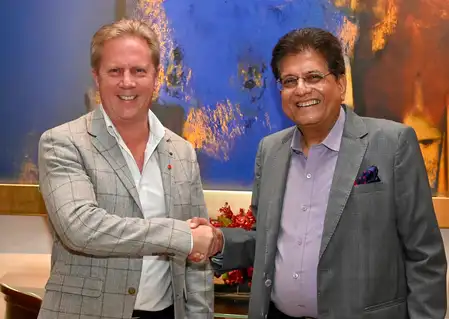
New Delhi, April 28 (IANS). Describing the Free Trade Agreement (FTA) between India and New Zealand as historic, Union Commerce and Industry Minister Piyush Goyal said that this agreement is not limited to trade in goods and services only, but it will open up immense possibilities in many new areas. Talking to the media, he said that under this agreement, there will now be zero duty on most of the products going from India to New Zealand, which will give a big boost to Indian exports.
The Union Minister further said that through this agreement the New Zealand market has been opened up for India in about 140 service sectors. Apart from this, partnership will also be promoted in areas like education, sports, culture, agricultural productivity and technical cooperation. He said that important agreements have also been signed on cooperation in the areas of intellectual property and traditional medicine, especially AYUSH.
Piyush Goyal said that the agreement reached in the pharmaceutical sector is especially important. Under this, if any Indian medicine is approved in developed countries like America or Europe, then it will be approved in New Zealand through fast track. This will greatly benefit Indian pharmaceutical companies and their reach in the global market will be further strengthened.
He further said that a major benefit of this comprehensive FTA will also be seen in the field of investment. New Zealand has invested about $70 million in India in the last 25 years, but now plans to invest about $20 billion (about Rs 2 lakh crore) in the next 15 years. This will create employment opportunities on a large scale in the country and strengthen trade and industry.
The minister further said that this agreement will be presented in the New Zealand Parliament. There both the ruling and opposition parties are supporting it. In such a situation, after getting approval from there soon, this agreement can be implemented by the end of this year.
The Union Minister said that this agreement will play an important role in achieving India’s goal of ‘Developed India 2047’ and will give a new impetus to the economic progress of the country in the Amrit period.
–IANS
DBP