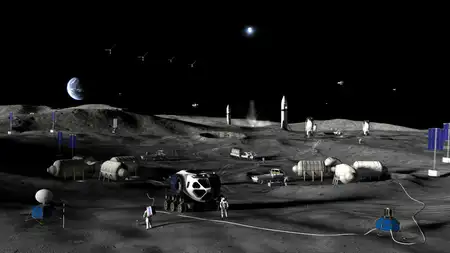
Washington, May 27 (IANS). American space agency NASA has taken a big step towards creating a long-term continuous presence of humans on the Moon. The agency has given information about detailed plans to deploy autonomous lunar drones, robotic rovers and strong communication networks in the south pole region of the Moon.
During the briefing of Moon Base Program at NASA Headquarters, officials said that now it is not limited to just landing on the Moon, but a permanent operational format will be prepared there. This will form the basis for future Artemis missions, scientific exploration, and missions to Mars.
A key part of this strategy is the Moonfall Drone Mission. This drone will explore the mysterious areas of the moon, discover water ice and prepare a safe landing site for future astronauts. NASA’s Jet Propulsion Laboratory (JPL) is building these drones, while Firefly Aerospace has been entrusted with the responsibility of building the carrier vehicle. The target is to launch this mission in the year 2028.
These drones will move slowly on the lunar surface. Especially we will explore those deep craters of the South Pole where sunlight never reaches. The drones will take high-resolution images, create maps with centimeter-level accuracy and test new technologies that work in the moon’s extremely cold temperatures.
Carlos Garcia Golan, Moon Base Program executive, said, “These drones will help us investigate the deep areas of the moon and know the real situation there.”
According to NASA, the future Moon Base will not be like a small station, but like a city spread over hundreds of square miles. Habitats would be built on high peaks where sunlight would be available, while nuclear power systems would be placed several kilometers away for safety reasons.
“As construction progresses, it will gradually take the form of a sprawling city,” said chief architect Nujod Merency.
The agency is also developing a strong communication and navigation network around the moon. It will include a constellation of satellites that will provide continuous support to robotic and human missions.
NASA Administrator Jared Isaacman called it part of a major change in space exploration. He said that NASA is carrying out such missions with full efficiency and clear objective.
–IANS
mt/pm