New Delhi, May 15 (IANS). The moon experiences scorching heat during the day and severe cold at night. In such a situation, the American space agency NASA has taken an important step forward in preparing materials for future missions to the Moon, Mars and other planets.
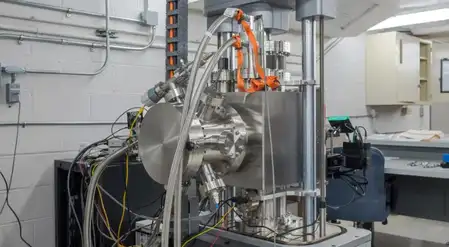
NASA has developed new technology that mimics the bitter cold of the Moon’s night, which will allow testing materials and devices without any liquid gas. Engineers at NASA’s Glenn Research Center (Cleveland) have created a machine called ‘Lunar Environment Structural Test Rig’ (LESTR). This machine can test materials, electronics and space hardware at extremely cold temperatures of up to 40 Kelvin i.e. approximately -388 degrees Fahrenheit.
NASA is planning to build a lunar base on the south pole of the Moon. The temperature there varies greatly during the day and night. In such a situation, normal rubber can break like glass, circuits can get damaged and electrical connections can get severed. Therefore, it is extremely important to understand the condition of materials in extreme temperatures. Earlier NASA used to conduct tests using liquid cryogen i.e. liquid nitrogen, hydrogen and helium. These extremely cold liquids were stored in special tanks. Now LESTR will be able to replace this old method.
The specialty of LESTR is that it is a completely dry system. No liquid is used in this. It removes heat using a high-power cryocooler.
“Just as no building can be built without proper knowledge of the materials, no space mission can be successful without knowing the proper behavior of the materials,” said Ariel Dimston, LESTR’s technical lead.
According to Dimston, LESTR is safer, cheaper and simpler than traditional methods. It does not require the complexities, safety equipment, special valves and sensors associated with liquid cryogen. This reduces time, cost and risk. This new technology will be useful in many areas.
Also, the NASA team is testing clothes for the next generation spacesuits, new materials for rover tires and ‘shape memory alloy’ i.e. metal that remembers its shape. This metal returns to its original shape even after being bent, stretched or cooled, which can prove to be very useful for rovers on the rough surface of the Moon and Mars.
–IANS
MT/AS