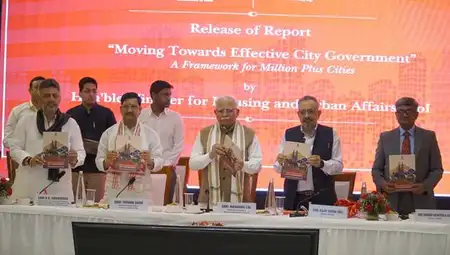
New Delhi, April 25 (IANS). NITI Aayog on Saturday released a report that offers a focused framework to address the structural challenges of the urban sector, such as fragmented institutional arrangements, limited devolution of powers, weak financial autonomy and lack of accountability.
The report says that it is very important to strengthen urban governance so that cities can function effectively. The report emphasizes on strengthening the institutional foundation as well as reforms in individual sectors, and gives priority to Indian cities with a population of more than 10 lakh. These cities are considered important economic centers which contribute a lot to the progress of the country.
Union Minister Manohar Lal Khattar released this report in an event. Urban Development Ministers from more than 10 states participated in the event, which shows the large scale participation and commitment to pursue reforms in urban governance.
Urbanization of India is very important to fulfill the dream of ‘Developed India’ by 2047 and move towards becoming a $30 trillion economy.
The role of cities is most important in promoting economic development, bringing new ideas and creating employment.
The report, titled ‘Towards Effective Urban Governance: A Framework for Cities with Populations Over 1 Million’, identifies persistent governance problems, including weak and fragmented leadership structures, limited financial capacity and lack of capacity. These shortcomings limit the delivery of services to people and the functioning of cities.
The report calls for greater empowerment of city governance by clearly redefinition of powers, responsibilities and resources at the city level. Such change is necessary for cities to act as effective engines of growth and provide services as per the needs of the people.
Key recommendations of the report include strengthening urban leadership. For this, it has been suggested to introduce the post of directly elected mayor, whose tenure will be fixed. Also, an empowered ‘Mayor-in-Council’ system is suggested, so that there is continuity, clarity and accountability in decision-making. Additionally, there is a suggestion to bring together urban services; Such as bringing important services like water supply, sanitation and public transport under the purview of urban governments, so that coordination and accountability can be improved.
The objective of this report is also to improve the finances of urban bodies. To this end, it is suggested to strengthen own source earnings, ensure more predictable and timely financial transfers through strong ‘State Finance Commissions’, and access to market-based financial instruments such as ‘municipal bonds’.
The report also suggests institutional restructuring. Under this, it has been said that many semi-government agencies involved in providing services to the people will be brought under the supervision of the city government, in which their roles will be clearly defined and the coordination structure between them will also be stronger.
To effectively implement these reforms, the report suggests states to amend their ‘Municipal Laws’ to incorporate these governance reforms. The report also calls on the ‘Ministry of Housing and Urban Affairs’ to update the ‘Model Municipal Law’, and provide guidance and incentives to help adopt these reforms. Highlighting the salient features of the report, Rajiv Gauba, Member, NITI Aayog, said that the report is the result of extensive discussions, evidence-based analysis and study of global best practices conducted together with a group of experts.
–IANS
SCH