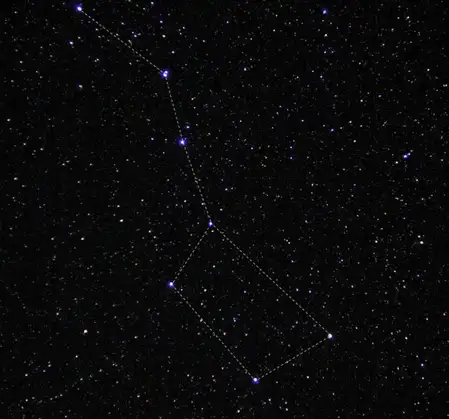
New Delhi, May 9 (IANS). When people see the shining stars in the dark night sky, the question definitely arises that what are these constellations and how do scientists use them? Scientists explain what exactly is this pattern of stars and what is its importance?
The American space agency gives detailed information about the constellation on NASA’s Space Place portal. Constellations are groups of stars, which appear like a particular shape or picture when seen from the Earth. These stars are not connected to each other, but are located at very different distances. Yet, when we look at them together, they appear to form the shape of animals, things or humans.
Human cultures have given names to these patterns since ancient times. Today there are 88 constellations officially recognized worldwide. Their names have varied in different cultures, but have been settled in modern astronomy. The constellations visible at night depend on your position on Earth and the time of year. The Earth revolves around the Sun. That’s why the night sky keeps changing in every season.
The stars appear to move slightly westward every night. Different constellations are also visible in the Northern Hemisphere and Southern Hemisphere. For example, if you look at the night sky in September in the Northern Hemisphere, you may see the constellation ‘Pisces’, but not ‘Virgo’ because it is on the other side of the Sun at that time.
Constellations may seem simple to see, but they help scientists understand the depth of the universe. Some stars appear close and some appear very far away. When we connect lines between them with imagination, beautiful shapes are formed.
Now the question is how do scientists use constellations? Planetariums are not just beautiful sights, but are also an important tool for scientists and space agencies because constellations remain at almost the same place for a long time, they are used as marks or landmarks in the sky. NASA and astronomers name stars, nebulae, and other celestial objects after the constellations in which they are located. The names of meteor showers are also taken from the associated constellations.
For example, the ‘Orionids’ meteor showers that occur every October appear to come from the direction of the ‘Orion’ constellation. The role of constellations in navigation is very old. For centuries, sailors have been using the stars to find their way at sea, which is called ‘celestial navigation’. Even today NASA astronauts take training in it. Constellations can serve as a backup if modern GPS or other systems fail.
Not only this, robotic spacecraft also use star maps. These vehicles keep a complete map of the stars in their computer and decide their path by comparing the pictures taken from the camera. In this way, old technology is still proving useful in modern space exploration.
–IANS
mt/pm